
Quantifying Case Strength Through Evidence, Judicial Response, and Legal Consequence
Quantifying Case Strength Through Evidence,
Judicial Response, and Legal Consequence
Christopher R. Harrison
Analyzed Discovery Ltd., Nevada, United States
[email protected]
Methods research article
October 2026
Abstract
Criminal defense assessment requires judgments about what the record supports, how the fo-
rum is likely to respond, and what obtaining relief would accomplish. This article presents a
formal additive scoring model that makes those judgments explicit and combines them under
a public numerical specification. Source-linked component ratings produce an issue index, lo-
gistic scaling supplies a bounded display, and consequence weighting summarizes the developed
defense position. The design is defended through traceability, separation of distinct judgments,
and mathematically interpretable aggregation. Symbolic derivation and exhaustive analysis of
5,508 permitted profiles establish the model’s ordering, sensitivity, and aggregation properties.
Across 11,376,774 cross-type profile comparisons, removing the structural adjustment produces
strict reversals in 5.27% of pairs, while removing all type adjustments produces strict reversals
in 20.19%. These results quantify the influence of declared assumptions over the design space.
The analysis also derives score-sensitivity bounds and the conditions under which issue subdivi-
sion preserves the aggregate. The model supplies a reproducible framework for examining how
factual judgments, institutional assumptions, and consequence priorities determine assessed de-
fense strength. Rating reliability and judicial outcome validation remain empirical tasks. The
contribution is a fully specified scoring rule, an account of its design choices, and reproducible
mathematical results available for independent examination.
Keywords. criminal defense; legal judgment; structured assessment; composite indices; sensitivity
analysis; formal models
1
Quantifying Case Strength
Harrison
Contents
1
Introduction
3
2
The construct and its boundaries
5
3
Constructing the assessment
6
4
Analytical study
9
5
Analytical results
11
6
Substantive choices in specification
16
7
Evaluation and validation
19
8
Discussion
21
9
Conclusion
23
A The disclosed numerical specification
24
B Derivations supporting the sensitivity analysis
25
Acknowledgments and declarations
25
References
26
C A Trial-Court Benchmark for Defense Issue Assessment
28
2

Quantifying Case Strength
Harrison
1 Introduction
Criminal defense counsel routinely assess three different questions. What proposition does the avail-
able record support? How is the relevant court likely to treat that proposition under the governing
law and procedural conditions?
What would success on the issue accomplish for the defense?
Those judgments can point in different directions. A well-supported objection may confront an
unfavorable institutional setting. A difficult suppression argument may concern the prosecution’s
central evidence. A highly persuasive impeachment point may have little effect on an independently
corroborated charge.
A scoring method must preserve those distinctions while explaining how they contribute to an
overall assessment. The problem has two levels. At the issue level, evidence and conditions of relief
must be combined into an assessment of a specified defense proposition. At the case level, issues with
different consequences must be summarized under an explicit priority rule. Combining everything
into a single intuitive conclusion leaves the relationship between those judgments unstated.
A
formal model makes that relationship an object of inspection.
This article presents such a model. Each developed defense issue receives a type-specific reference
position, an evidentiary rating, a forum and authority rating, and a bounded contextual adjustment.
Addition produces an issue index.
A logistic transformation places the index on a common 0–
100 display. A consequence-weighted mean of the issue indices summarizes the developed defense
position. The model therefore formalizes a sequence of professional judgments and the rule for
combining them. It specifies what each number represents, what supports its assignment, and how
changing it changes the result.
The methodological claim is that defense assessment can be made explicit through a compact
scoring architecture whose assumptions and consequences are open to examination. The design
places factual support, institutional reception, and the consequence of relief in identifiable roles.
Source-linked reasons expose the basis of a rating. A fixed combination rule defines the numerical
tradeoffs. Analytical results establish which conclusions follow from the rule and which depend
on its chosen settings. These features provide the basis for defending the method as a research
instrument and evaluating competing specifications.
Research on judgment supports investigating this approach. Dawes (1979) examined linear judg-
ment models whose weights are assigned without optimizing their fit to observed outcomes. Grove
et al. (2000) found that mechanical combination often matched or exceeded clinical judgment in
the domains studied. The relevant methodological precedent is the use of explicit combination rules
even when judgment supplies the inputs. Whether the present legal specification improves ranking,
forecasting, or professional decisions requires its own evidence.
The paper makes three contributions. It specifies an issue-scoring and case-aggregation model with
an explicit account of the intended construct. It derives the mathematical properties needed to
interpret the scores, including sensitivity bounds and conditions for aggregation invariance.
It
exhaustively evaluates the disclosed rating grid to show how type assumptions, component spacing,
3

Quantifying Case Strength
Harrison
and issue formulation affect the output.
The reference settings are held fixed throughout the
analysis. Alternative specifications isolate the effects of particular choices.
Public disclosure is part of the method’s research value. It makes the parameters, source require-
ments, equations, and reported results available for independent implementation and criticism. The
present contribution is the specified assessment architecture and the analysis reported here. Ad-
dition, logistic scaling, and weighted averaging are established mathematical operations. Judicial
outcome validation is a subsequent empirical test of the disclosed model, while this paper supplies
the model and its mathematical examination.
1.1 Relationship to existing methods
Multiattribute decision methods provide a relevant foundation for decomposing judgments. Ed-
wards and Barron (1994) describe practical additive models with explicit assessment of attribute
scales, ranges, and tradeoffs. Luce and Tukey (1964) show, at the level of measurement theory, that
additive interval representations require substantive conditions on comparisons. These traditions
support examining an explicit combination rule while directing attention to what its numerical
increments mean. They do not establish that legal rating categories have equal intervals or that
a unit of evidentiary merit should exchange exactly for a unit of forum assessment. (Edwards &
Barron, 1994; Luce & Tukey, 1964)
Legal evidence models preserve structures that a scalar necessarily compresses. Fenton, Neil, and
Lagnado (2013) use Bayesian networks to represent hypotheses, evidence accuracy, and dependen-
cies. Bex et al. (2010) connect evidential arguments with explanatory narratives, including support,
contradiction, and gaps. The present framework records a judgment about a developed issue rather
than reconstructing the full inferential network. Its source-linked reasons are therefore essential
to interpretation. A numerical merit rating cannot substitute for examining the supporting and
defeating evidence. (Fenton et al., 2013; Bex et al., 2010)
Litigation decision analysis already combines explicit issue assessment with consequences. Victor
(2015) describes conditional decision paths, case valuation, and the costs and uncertainties relevant
to settlement. A consequence-weighted mean of issue indices has a different target. It describes the
assessed issue set without specifying action alternatives, joint outcome probabilities, or a utility
function. It therefore does not inherit the decision-theoretic interpretation of a litigation decision
tree. (Victor, 2015)
Structured professional judgment must also be distinguished from mechanical aggregation. In one
forensic risk study, structured final judgments supplied predictive information beyond a numerical
instrument score. That result concerns another domain, but it illustrates why the relative merits
of professional synthesis and a fixed combination rule require evaluation. Neither the clinical litera-
ture nor research on simple linear models establishes which approach improves defense assessment.
(Douglas et al., 2003)
Composite-indicator research supplies the closest precedent for the present analytical design.
Saisana, Saltelli, and Tarantola (2005) study how modeling choices affect indices and rankings.
4
Quantifying Case Strength
Harrison
Paruolo, Saisana, and Saltelli (2013) distinguish nominal coefficients from actual influence across
a distribution of observations. Accordingly, this article examines explicit changes to assumptions
and reports the conditions under which conclusions remain stable.
Stability within a specified
analysis is evidence about that specification’s behavior, rather than evidence that its ratings or
predicted outcomes are correct. (Saisana et al., 2005; Paruolo et al., 2013)
2 The construct and its boundaries
2.1 Defense issue strength
Defense issue strength is the degree to which a specified defense proposition, developed from an
identified record, has evidentiary support and is positioned to obtain a specified legal or tactical
benefit in a specified forum and procedural posture. An issue may concern suppression, exclusion
of evidence, an element of an offense, or impeachment.
Its description must identify both the
proposition and the intended benefit.
“Witness credibility,” without a more specific claim and
purpose, is not a sufficiently defined unit.
The assessment is conditional on the available record and the formulation of the issue. It does not
describe every fact that exists or every defense that might be developed. A higher index expresses
a more favorable assessment under the declared conventions. Whether the ordering agrees with
independent professional assessments or observed outcomes remains an empirical question.
Strength and consequence require separate treatment. A minor impeachment point may be well
supported while offering little practical benefit. A difficult motion may have substantial conse-
quences if granted. Combining those dimensions too early makes it unclear whether an issue is
described as strong because it is well supported or because success would matter. The framework
therefore constructs an issue-strength index first and introduces consequence weights only when
summarizing a set of issues.
Neither dimension alone determines the best next use of counsel’s time. Deadlines, preservation
requirements, investigation costs, and the potential value of obtaining additional evidence also
affect strategy. Similarly, issue strength is not synonymous with acquittal probability, sentencing
exposure, plea value, or the expected benefit of filing a motion. Those quantities require additional
definitions and models of the processes that produce them.
2.2 A formative index
The proposed assessment is a formative composite.
Its components constitute the operational
index. They are not interchangeable manifestations of a single latent trait. Strong factual support
can coexist with an unfavorable procedural setting. Consequently, a high correlation among every
component is not a prerequisite for a useful assessment, and low internal consistency would not by
itself establish failure. Measurement theory distinguishes indicators that constitute an assessment
from indicators that reflect an underlying variable. (Bollen & Lennox, 1991)
5

Quantifying Case Strength
Harrison
This interpretation does not establish validity by definition. It directs attention to whether the com-
ponents cover the intended construct, whether their ratings have defensible meanings, and whether
their combination supports the intended use. Construct validation also requires relationships with
observations beyond the index’s own formula. (Cronbach & Meehl, 1955)
Several relationships are testable. Within comparable issue types and procedural settings, stronger
independently assessed factual support should generally accompany higher indices. Blinded counsel
should tend to rank higher-scored issues more favorably. Among issues sharing a defined adjudica-
tive endpoint, higher scores should tend to precede favorable rulings. Changes to legally irrelevant
features of otherwise equivalent records should not change the assessment. These hypotheses con-
cern the meaning of the index rather than its arithmetic alone.
2.3 The object of a case summary
A summary across issues needs its own construct definition. This article considers the consequence-
weighted central tendency of the developed issues’ indices. It describes the center of a distribution
under stated priorities. It does not describe the probability that at least one issue will succeed or
the combined strategic value of every available defense.
The distinction has an immediate implication. Developing an additional viable issue can increase
counsel’s options while lowering an average if the new issue lies below the existing mean. A summary
must therefore be interpreted with the included issue set, the record boundary, and the consequence
weights. Comparisons across cases or over time require attention to differences in those conditions.
3 Constructing the assessment
3.1 Unit, components, and sources
The unit of analysis is an issue with a stated proposition, requested benefit, decision maker, and
procedural stage.
An assessment should establish inclusion rules before calculating scores and
should account for excluded or unassessable issues. A set of issues developed from one record is
an enumeration under those rules, not a probability sample of cases or defendants. Issues may
share a witness, document, event, or legal premise; separate entries do not make them independent
observations.
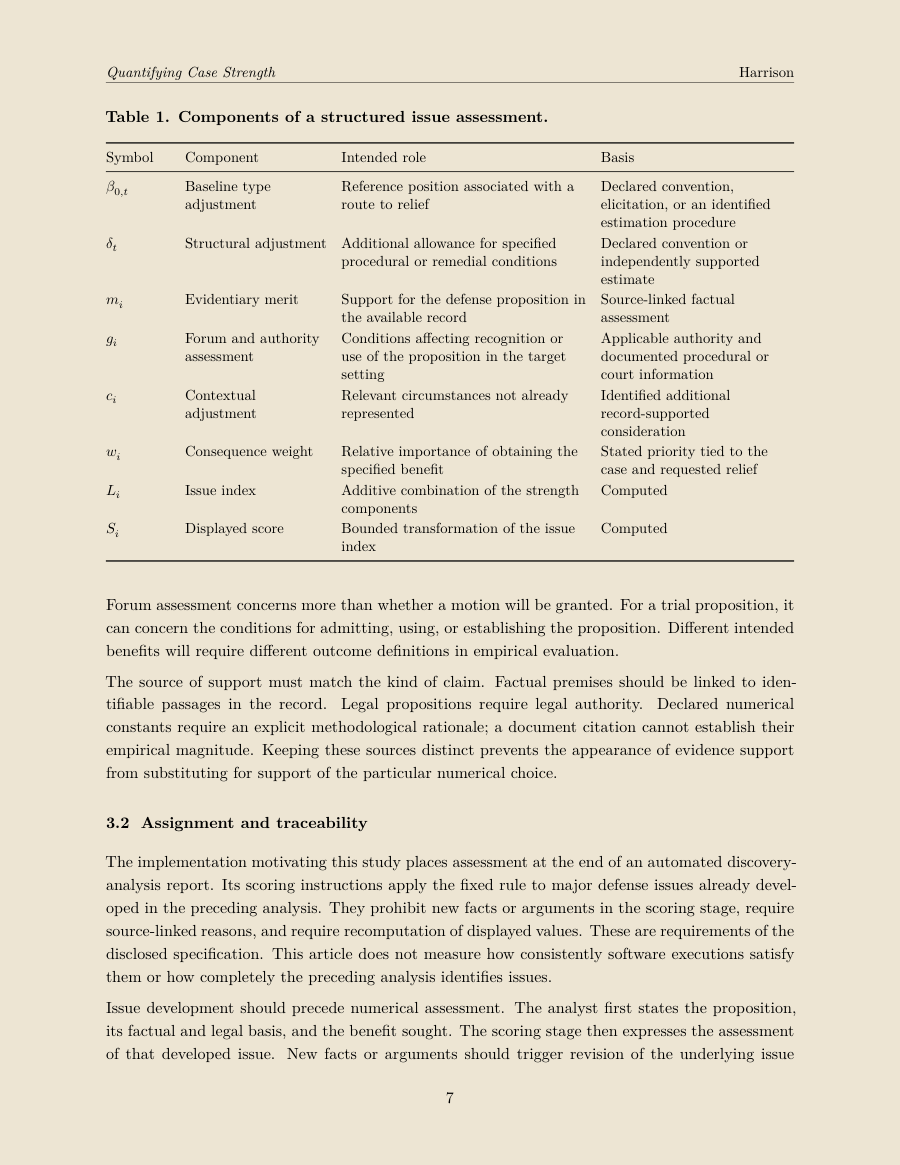
For issue 𝑖, let 𝑡(𝑖) denote its assigned type. Table 1 separates the components by their intended
function. The notation distinguishes two possible type adjustments so that their relationship can
be examined. An implementation may instead use their combined value directly.
6
Quantifying Case Strength
Harrison
Table 1. Components of a structured issue assessment.
Symbol
Component
Intended role
Basis
𝛽0,𝑡
Baseline type
adjustment
Reference position associated with a
route to relief
Declared convention,
elicitation, or an identified
estimation procedure
𝛿𝑡
Structural adjustment
Additional allowance for specified
procedural or remedial conditions
Declared convention or
independently supported
estimate
𝑚𝑖
Evidentiary merit
Support for the defense proposition in
the available record
Source-linked factual
assessment
𝑔𝑖
Forum and authority
assessment
Conditions affecting recognition or
use of the proposition in the target
setting
Applicable authority and
documented procedural or
court information
𝑐𝑖
Contextual
adjustment
Relevant circumstances not already
represented
Identified additional
record-supported
consideration
𝑤𝑖
Consequence weight
Relative importance of obtaining the
specified benefit
Stated priority tied to the
case and requested relief
𝐿𝑖
Issue index
Additive combination of the strength
components
Computed
𝑆𝑖
Displayed score
Bounded transformation of the issue
index
Computed
Forum assessment concerns more than whether a motion will be granted. For a trial proposition, it
can concern the conditions for admitting, using, or establishing the proposition. Different intended
benefits will require different outcome definitions in empirical evaluation.
The source of support must match the kind of claim. Factual premises should be linked to iden-
tifiable passages in the record.
Legal propositions require legal authority.
Declared numerical
constants require an explicit methodological rationale; a document citation cannot establish their
empirical magnitude. Keeping these sources distinct prevents the appearance of evidence support
from substituting for support of the particular numerical choice.
3.2 Assignment and traceability
The implementation motivating this study places assessment at the end of an automated discovery-
analysis report. Its scoring instructions apply the fixed rule to major defense issues already devel-
oped in the preceding analysis. They prohibit new facts or arguments in the scoring stage, require
source-linked reasons, and require recomputation of displayed values. These are requirements of the
disclosed specification. This article does not measure how consistently software executions satisfy
them or how completely the preceding analysis identifies issues.
Issue development should precede numerical assessment. The analyst first states the proposition,
its factual and legal basis, and the benefit sought. The scoring stage then expresses the assessment
of that developed issue. New facts or arguments should trigger revision of the underlying issue
7
Quantifying Case Strength
Harrison
analysis rather than enter silently as a numerical adjustment. This sequence also makes it possible
to distinguish a change in judgment from a change in the material being judged.
Each rated component should have a reason and a source reference. The issue description, type
assignment, component values, consequence weight, and explicit calculation should be available to-
gether. These materials permit a reader to locate disagreement. A source may have been misread,
contrary evidence omitted, a consideration assigned to the wrong component, or a rating chosen in-
consistently. Traceability facilitates review; it does not establish that the underlying interpretation
is correct.
Merit and forum assessment should have separate assigned subject matter. Merit concerns the
evidentiary support for the proposition. Forum assessment concerns the legal and institutional
conditions for obtaining the stated benefit.
A rule requiring that separation cannot establish
statistical independence. The same circumstances may influence both assessments, and evidentiary
strength may affect how a court receives an issue. The practical requirement is to state where a
consideration enters and to justify any repeated contribution.
Within the forum rationale, governing authority and observed institutional practice should remain
separately traceable. Authority supplies the applicable legal conditions. Historical decisions may
supply evidence about how comparable issues are treated collectively in a jurisdiction, procedural
setting, and period. An observed ruling does not itself establish the correctness of the legal analysis.
The present specification retains one forum rating, but its rationale should identify these different
sources and any tension between them. A claimed practice pattern requires an identified evidentiary
basis rather than an assumption about individual judges.
A residual contextual component requires similar discipline. It should identify a relevant considera-
tion that the other components miss and explain its direction. An explicit zero is appropriate when
an adequate review identifies no additional adjustment. A zero assigned because the necessary infor-
mation is unavailable has a different meaning and should not be presented as an evidence-supported
neutral judgment.
Calculations should be recomputed independently of the narrative assessment. The same inputs
must produce the same numerical output, regardless of whether ratings are supplied by counsel,
another analyst, or an automated system. Arithmetic consistency is a property that can be enforced
deterministically. Agreement on the ratings themselves requires a separate reliability study.
3.3 Classification, missingness, and scale construction
Classification matters whenever issue types receive different adjustments. A taxonomy that com-
bines procedural categories, such as suppression, with categories describing evidence quality can
produce overlap. The same corroborated proposition may support impeachment, an element dis-
pute, or a motion. A classification manual should explain which characteristic controls, link distinct
legal uses of shared evidence, and state how unresolved classifications are handled. Where two as-
signments remain defensible, their effects can be reported through sensitivity analysis.
8

Quantifying Case Strength
Harrison
Rating scales also require substantive anchors. Adjacent numerical values should correspond to
distinctions the record and applicable authority can support. Regularly spaced codes make calcu-
lation straightforward but assume that the represented steps can be treated as equal increments.
Coarse categories can reduce the number of distinctions requested of a rater; they do not establish
that those distinctions are reliable.
When an input lacks a defensible basis, the assessment should identify it as unresolved. Conditional
scenarios or a range may be more informative than an unconditional point score.
A summary
based only on assessable issues must identify that subset and the omissions. An empty set has no
defined mean. These reporting choices make the information boundary visible rather than allowing
missingness to enter as an undisclosed rating convention.
Reproducibility requires the record version, inclusion rules, classification and rating manuals, and
numerical specification. Automated rating additionally requires the model and software versions,
instructions, relevant settings, and source-retrieval procedures. Reproducible arithmetic conditional
on those inputs remains distinct from repeatable judgments and complete issue identification.
Supplementary Material 1 supplies a proposed operational codebook with issue boundaries, avail-
ability rules, rating anchors, classification precedence, and treatment of missing information. Those
conventions have not been tested with raters and are not claimed to have governed prior reports.
Separating the disclosed numerical specification from proposed operational refinements prevents a
revised manual from being mistaken for evidence about an existing implementation.
4 Analytical study
4.1 Design and reference specification
The study combines symbolic derivation with complete enumeration of the reference specification’s
permitted component codes. A local analysis plan was written before the calculations were executed
and is included with the reproducibility materials. It was not externally preregistered. There is no
sampled case series, simulated judicial outcome, or claim of empirical validation.
Merit and forum assessment each have nine permitted codes, from −2.0 to +2.0 in half-unit incre-
ments. Context has seventeen codes, from −0.8 to +0.8 in tenth-unit increments. Their Cartesian
product contains 9 × 9 × 17 = 1,377 profiles for each of four issue types, or 5,508 typed profiles.
The type adjustments, their component split, and consequence weights are disclosed in Appendix A.
Enumeration retains every permitted numerical combination, including combinations that may be
uncommon, legally incoherent, or excluded by a future operational codebook. It does not impose
a probability distribution on actual issues.
The cross-type ordering analysis compares every profile of one type with every profile of each other
type. Each of the six unordered type pairs contributes 1,3772 = 1,896,129 comparisons, producing
11,376,774 comparisons overall. Profiles with the same summed ratings retain their multiplicity
because they are distinct permitted assignments. The resulting fractions depend on the grid and
the equal enumeration of type pairs. They are design-space summaries, not population estimates.
9

Quantifying Case Strength
Harrison
4.2 Comparators and sensitivity definitions
Two comparators isolate the role of the fixed settings. The first removes the structural adjustment
𝛿𝑡while retaining the baseline 𝛽0,𝑡. The second removes both type adjustments while retaining
the rated components. Neither comparator is selected or assessed using court outcomes. A strict
reversal requires a positive difference between two issues under one rule and a negative difference
under the other. Ties in either rule are reported separately. Within-type comparisons are unchanged
by these operations and do not enter the cross-type denominator.
A second analysis considers componentwise dominance. For each pair of types, the lower-offset
issue must be at least as favorable on every rated component and strictly more favorable on at
least one. The analysis asks whether that advantage survives the difference in type adjustments.
Cross-type dominance is a diagnostic of what the offsets can outweigh; it is not assumed to settle
substantive comparisons between different remedies.
Rating sensitivity allows deviations of up to one permitted step from a reference profile in each
component, namely 0.5 in merit, 0.5 in forum assessment, and 0.1 in context. Each deviation is
clipped at its component’s endpoints. The resulting lower and upper scores form a conditional
sensitivity envelope. Opposite endpoints can differ by two steps per component. The envelope is
not a confidence interval, and its construction does not assert that these disagreements occur with
any particular frequency.
The aggregation analysis derives the effects of priority weights, issue addition, and subdivision.
A separate ordinal-recoding counterexample examines whether the framework depends only on
category order or also on the assigned numerical spacing. Recoding changes the specification and
is not treated as another allowed rating under the frozen reference rule.
4.3 Computation and verification
All profile-index calculations and ordering comparisons use integer tenths.
Logistic values are
computed at full floating-point precision and rounded only for display. The main analysis uses
Python 3.14.7 and the standard library. A direct enumeration checks the frequency representation
used in the ordering calculations. A separately written verifier uses sorted totals and binary-search
bounds to reproduce the reversal counts. Algebraic identities are also checked over a deterministic
grid of 343 triples. These checks address implementation errors; the mathematical arguments supply
the general results.
The code, analysis plan, full profile grid, comparison counts, and proposed codebook accompany
the article as supplementary materials. No significance tests, outcome-performance statistics, or
sampling confidence intervals are calculated. AI assistance in preparing the text, code, and technical
checks is disclosed in the acknowledgments.
10
Quantifying Case Strength
Harrison
5 Analytical results
5.1 Additive construction and its assumptions
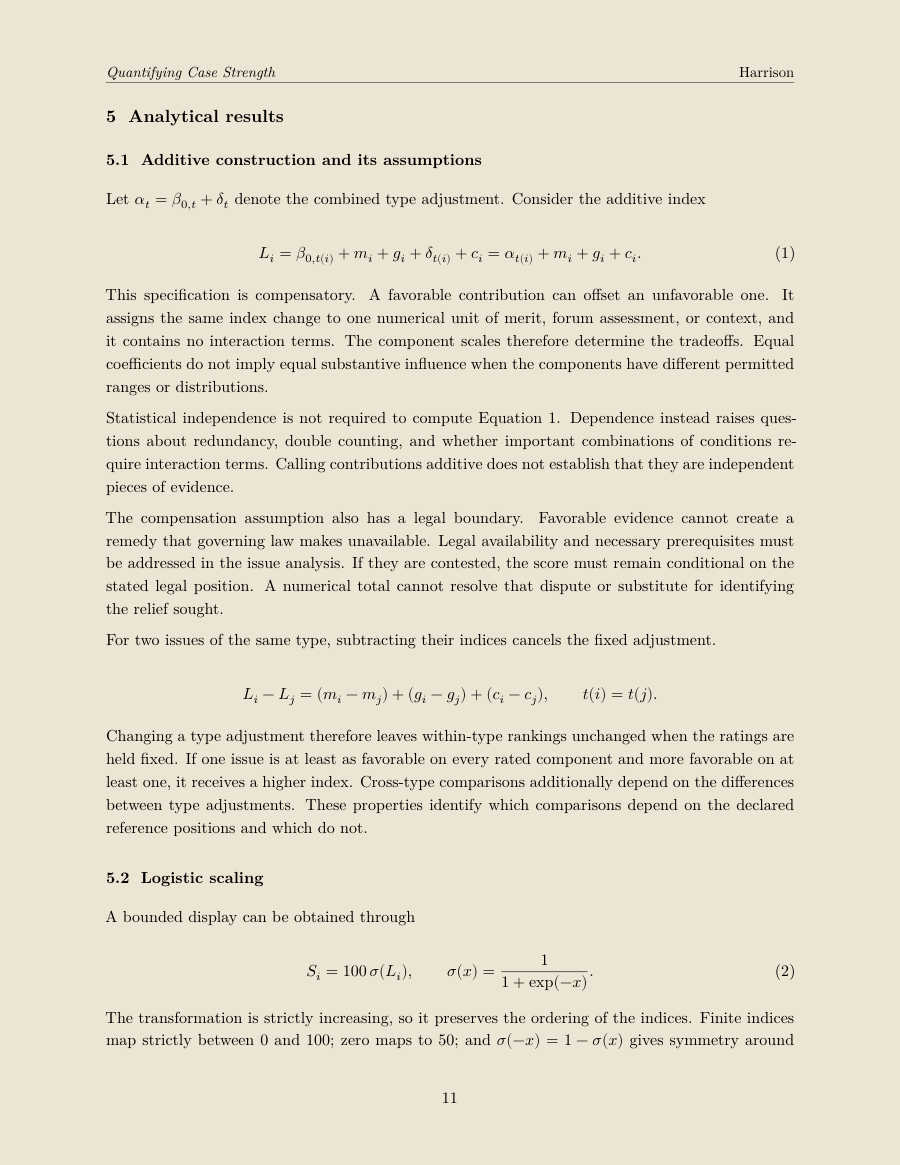
Let 𝛼𝑡= 𝛽0,𝑡+ 𝛿𝑡denote the combined type adjustment. Consider the additive index
𝐿𝑖= 𝛽0,𝑡(𝑖) + 𝑚𝑖+ 𝑔𝑖+ 𝛿𝑡(𝑖) + 𝑐𝑖= 𝛼𝑡(𝑖) + 𝑚𝑖+ 𝑔𝑖+ 𝑐𝑖.
(1)
This specification is compensatory.
A favorable contribution can offset an unfavorable one.
It
assigns the same index change to one numerical unit of merit, forum assessment, or context, and
it contains no interaction terms. The component scales therefore determine the tradeoffs. Equal
coefficients do not imply equal substantive influence when the components have different permitted
ranges or distributions.
Statistical independence is not required to compute Equation 1. Dependence instead raises ques-
tions about redundancy, double counting, and whether important combinations of conditions re-
quire interaction terms. Calling contributions additive does not establish that they are independent
pieces of evidence.
The compensation assumption also has a legal boundary.
Favorable evidence cannot create a
remedy that governing law makes unavailable. Legal availability and necessary prerequisites must
be addressed in the issue analysis. If they are contested, the score must remain conditional on the
stated legal position. A numerical total cannot resolve that dispute or substitute for identifying
the relief sought.
For two issues of the same type, subtracting their indices cancels the fixed adjustment.
𝐿𝑖−𝐿𝑗= (𝑚𝑖−𝑚𝑗) + (𝑔𝑖−𝑔𝑗) + (𝑐𝑖−𝑐𝑗),
𝑡(𝑖) = 𝑡(𝑗).
Changing a type adjustment therefore leaves within-type rankings unchanged when the ratings are
held fixed. If one issue is at least as favorable on every rated component and more favorable on at
least one, it receives a higher index. Cross-type comparisons additionally depend on the differences
between type adjustments. These properties identify which comparisons depend on the declared
reference positions and which do not.
5.2 Logistic scaling
A bounded display can be obtained through
𝑆𝑖= 100 𝜎(𝐿𝑖),
𝜎(𝑥) =
1
1 + exp(−𝑥).
(2)
The transformation is strictly increasing, so it preserves the ordering of the indices. Finite indices
map strictly between 0 and 100; zero maps to 50; and 𝜎(−𝑥) = 1 −𝜎(𝑥) gives symmetry around
11
Quantifying Case Strength
Harrison
that midpoint. The slope declines toward the extremes. These are properties of the chosen display,
not empirical findings about how legal strength or judicial behavior varies.
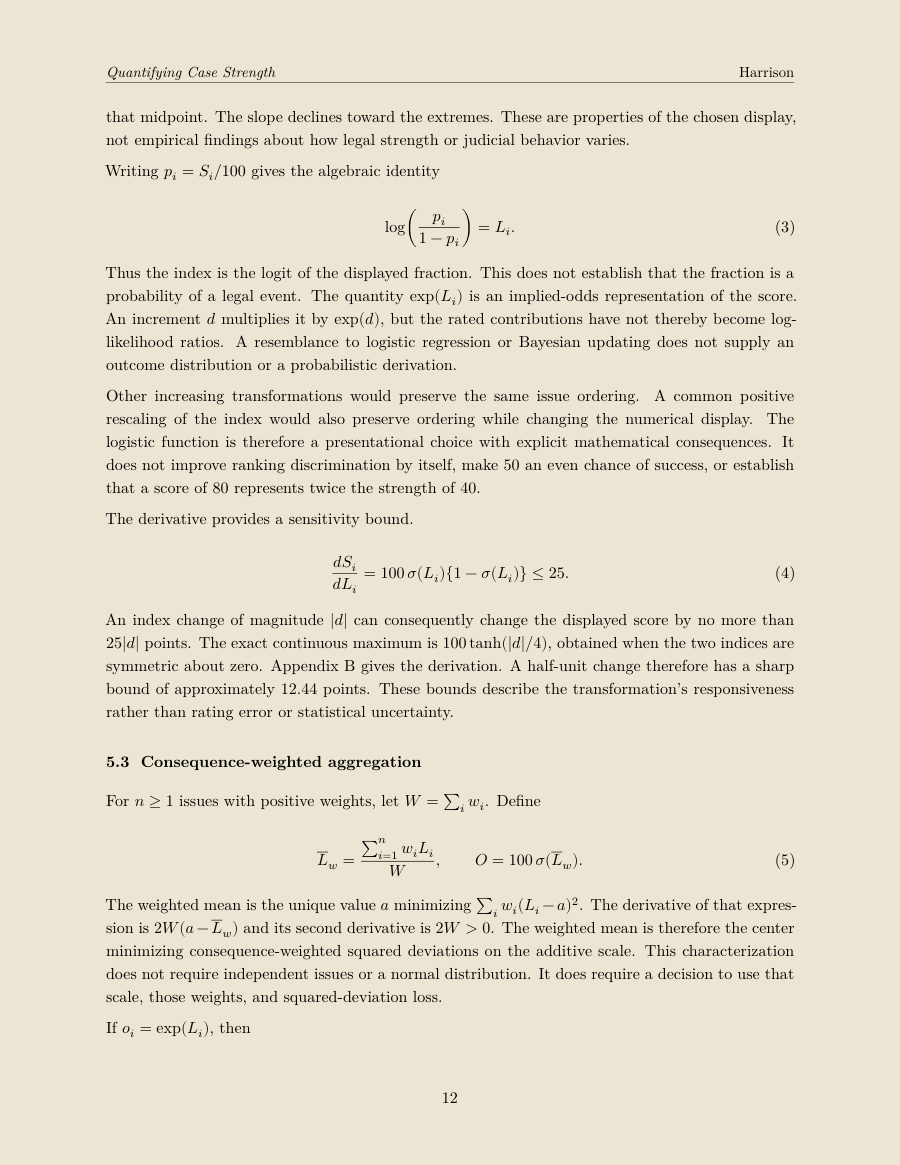
Writing 𝑝𝑖= 𝑆𝑖/100 gives the algebraic identity
log(
𝑝𝑖
1 −𝑝𝑖
) = 𝐿𝑖.
(3)
Thus the index is the logit of the displayed fraction. This does not establish that the fraction is a
probability of a legal event. The quantity exp(𝐿𝑖) is an implied-odds representation of the score.
An increment 𝑑multiplies it by exp(𝑑), but the rated contributions have not thereby become log-
likelihood ratios. A resemblance to logistic regression or Bayesian updating does not supply an
outcome distribution or a probabilistic derivation.
Other increasing transformations would preserve the same issue ordering.
A common positive
rescaling of the index would also preserve ordering while changing the numerical display.
The
logistic function is therefore a presentational choice with explicit mathematical consequences. It
does not improve ranking discrimination by itself, make 50 an even chance of success, or establish
that a score of 80 represents twice the strength of 40.
The derivative provides a sensitivity bound.
𝑑𝑆𝑖
𝑑𝐿𝑖
= 100 𝜎(𝐿𝑖){1 −𝜎(𝐿𝑖)} ≤25.
(4)
An index change of magnitude |𝑑| can consequently change the displayed score by no more than
25|𝑑| points. The exact continuous maximum is 100 tanh(|𝑑|/4), obtained when the two indices are
symmetric about zero. Appendix B gives the derivation. A half-unit change therefore has a sharp
bound of approximately 12.44 points. These bounds describe the transformation’s responsiveness
rather than rating error or statistical uncertainty.
5.3 Consequence-weighted aggregation
For 𝑛≥1 issues with positive weights, let 𝑊= ∑𝑖𝑤𝑖. Define
𝐿𝑤= ∑
𝑛
𝑖=1 𝑤𝑖𝐿𝑖
𝑊
,
𝑂= 100 𝜎(𝐿𝑤).
(5)
The weighted mean is the unique value 𝑎minimizing ∑𝑖𝑤𝑖(𝐿𝑖−𝑎)2. The derivative of that expres-
sion is 2𝑊(𝑎−𝐿𝑤) and its second derivative is 2𝑊> 0. The weighted mean is therefore the center
minimizing consequence-weighted squared deviations on the additive scale. This characterization
does not require independent issues or a normal distribution. It does require a decision to use that
scale, those weights, and squared-deviation loss.
If 𝑜𝑖= exp(𝐿𝑖), then
12
Quantifying Case Strength
Harrison
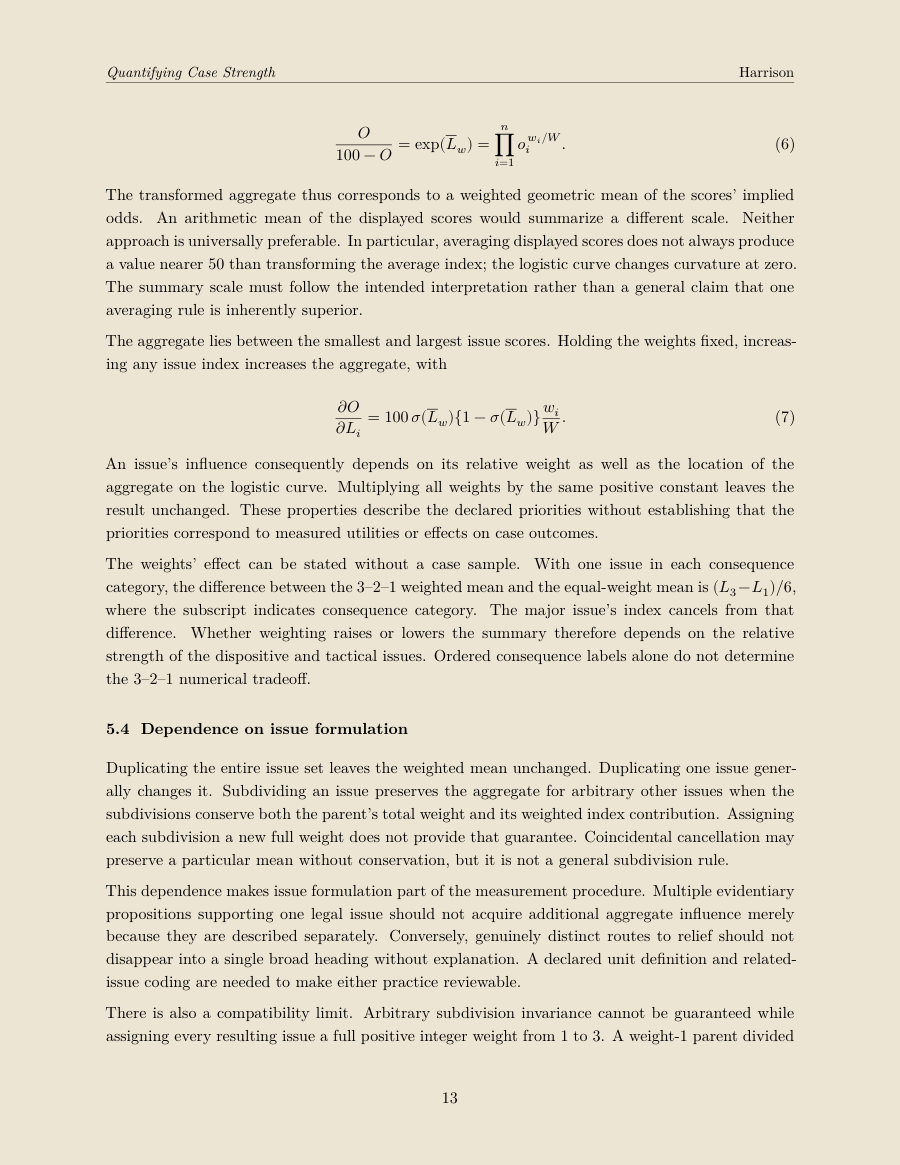
𝑂
100 −𝑂= exp(𝐿𝑤) =
𝑛
∏
𝑖=1
𝑜𝑤𝑖/𝑊
𝑖
.
(6)
The transformed aggregate thus corresponds to a weighted geometric mean of the scores’ implied
odds.
An arithmetic mean of the displayed scores would summarize a different scale.
Neither
approach is universally preferable. In particular, averaging displayed scores does not always produce
a value nearer 50 than transforming the average index; the logistic curve changes curvature at zero.
The summary scale must follow the intended interpretation rather than a general claim that one
averaging rule is inherently superior.
The aggregate lies between the smallest and largest issue scores. Holding the weights fixed, increas-
ing any issue index increases the aggregate, with
𝜕𝑂
𝜕𝐿𝑖
= 100 𝜎(𝐿𝑤){1 −𝜎(𝐿𝑤)}𝑤𝑖
𝑊.
(7)
An issue’s influence consequently depends on its relative weight as well as the location of the
aggregate on the logistic curve. Multiplying all weights by the same positive constant leaves the
result unchanged. These properties describe the declared priorities without establishing that the
priorities correspond to measured utilities or effects on case outcomes.
The weights’ effect can be stated without a case sample.
With one issue in each consequence
category, the difference between the 3–2–1 weighted mean and the equal-weight mean is (𝐿3−𝐿1)/6,
where the subscript indicates consequence category. The major issue’s index cancels from that
difference.
Whether weighting raises or lowers the summary therefore depends on the relative
strength of the dispositive and tactical issues. Ordered consequence labels alone do not determine
the 3–2–1 numerical tradeoff.
5.4 Dependence on issue formulation
Duplicating the entire issue set leaves the weighted mean unchanged. Duplicating one issue gener-
ally changes it. Subdividing an issue preserves the aggregate for arbitrary other issues when the
subdivisions conserve both the parent’s total weight and its weighted index contribution. Assigning
each subdivision a new full weight does not provide that guarantee. Coincidental cancellation may
preserve a particular mean without conservation, but it is not a general subdivision rule.
This dependence makes issue formulation part of the measurement procedure. Multiple evidentiary
propositions supporting one legal issue should not acquire additional aggregate influence merely
because they are described separately. Conversely, genuinely distinct routes to relief should not
disappear into a single broad heading without explanation. A declared unit definition and related-
issue coding are needed to make either practice reviewable.
There is also a compatibility limit. Arbitrary subdivision invariance cannot be guaranteed while
assigning every resulting issue a full positive integer weight from 1 to 3. A weight-1 parent divided
13
Quantifying Case Strength
Harrison
into two identical children would require the children’s weights to sum to 1 for invariance in arbitrary
surrounding issue sets. Two permitted positive integer weights cannot meet that condition. The
implementation must therefore control the issue unit, restrict subdivisions, or adopt a different
rule for allocating group influence. This is a mathematical constraint on the specification, not an
observed defect rate.
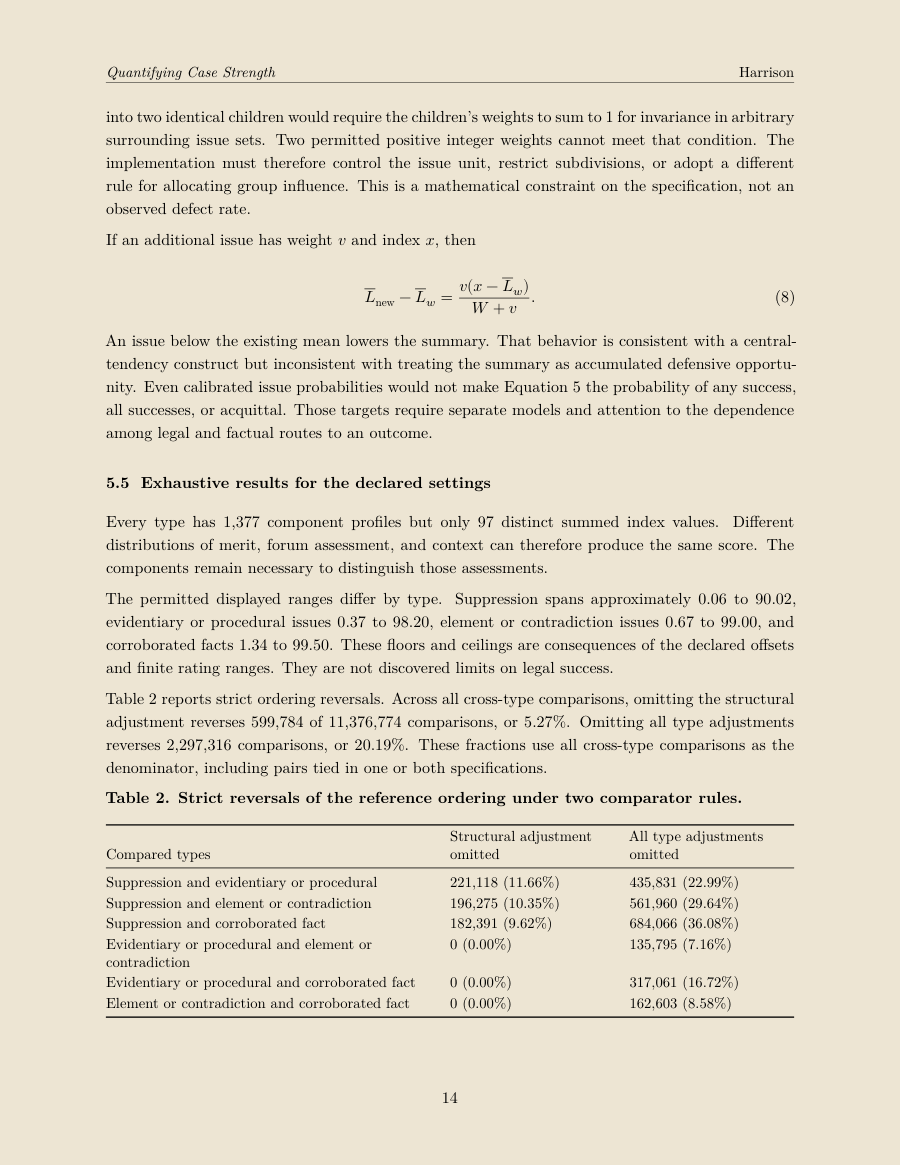
If an additional issue has weight 𝑣and index 𝑥, then
𝐿new −𝐿𝑤= 𝑣(𝑥−𝐿𝑤)
𝑊+ 𝑣
.
(8)
An issue below the existing mean lowers the summary. That behavior is consistent with a central-
tendency construct but inconsistent with treating the summary as accumulated defensive opportu-
nity. Even calibrated issue probabilities would not make Equation 5 the probability of any success,
all successes, or acquittal. Those targets require separate models and attention to the dependence
among legal and factual routes to an outcome.
5.5 Exhaustive results for the declared settings
Every type has 1,377 component profiles but only 97 distinct summed index values.
Different
distributions of merit, forum assessment, and context can therefore produce the same score. The
components remain necessary to distinguish those assessments.
The permitted displayed ranges differ by type. Suppression spans approximately 0.06 to 90.02,
evidentiary or procedural issues 0.37 to 98.20, element or contradiction issues 0.67 to 99.00, and
corroborated facts 1.34 to 99.50. These floors and ceilings are consequences of the declared offsets
and finite rating ranges. They are not discovered limits on legal success.
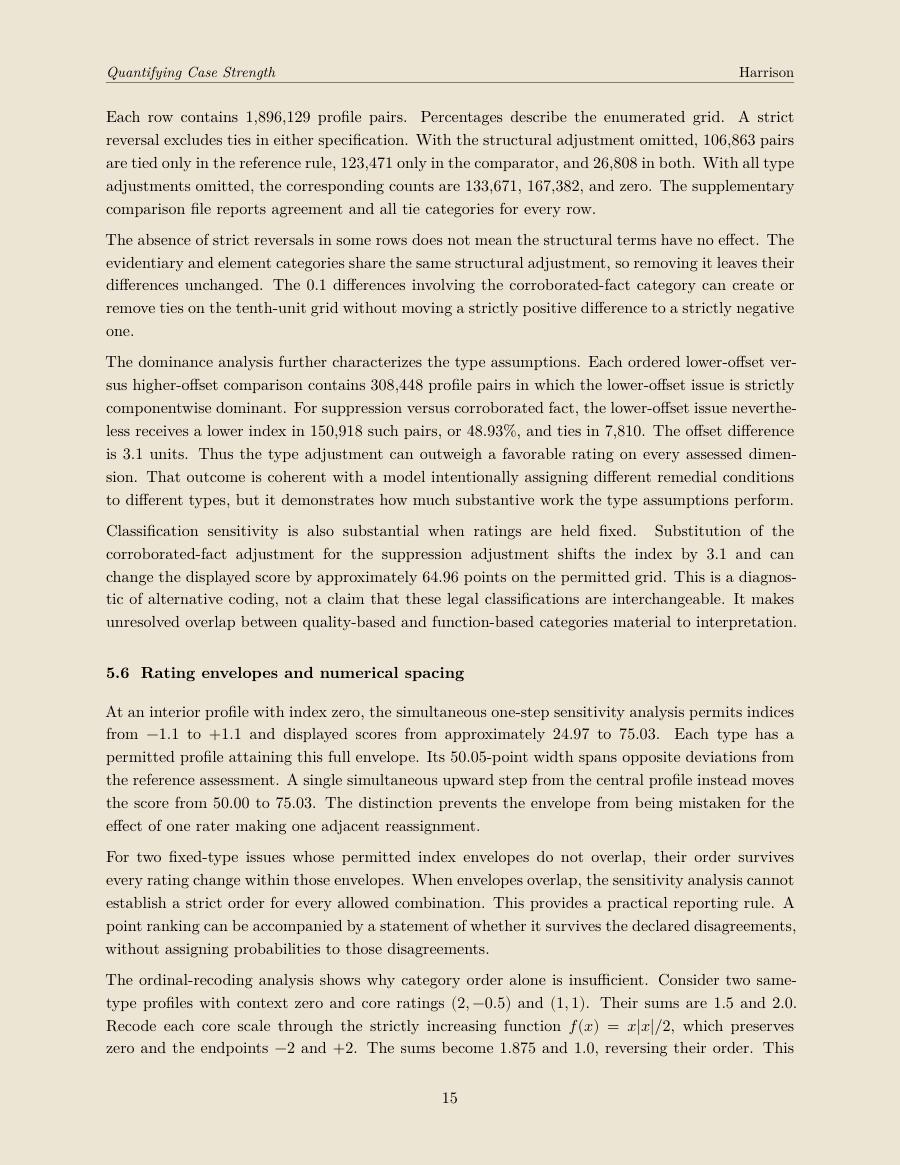
Table 2 reports strict ordering reversals. Across all cross-type comparisons, omitting the structural
adjustment reverses 599,784 of 11,376,774 comparisons, or 5.27%. Omitting all type adjustments
reverses 2,297,316 comparisons, or 20.19%. These fractions use all cross-type comparisons as the
denominator, including pairs tied in one or both specifications.
Table 2. Strict reversals of the reference ordering under two comparator rules.
Compared types
Structural adjustment
omitted
All type adjustments
omitted
Suppression and evidentiary or procedural
221,118 (11.66%)
435,831 (22.99%)
Suppression and element or contradiction
196,275 (10.35%)
561,960 (29.64%)
Suppression and corroborated fact
182,391 (9.62%)
684,066 (36.08%)
Evidentiary or procedural and element or
contradiction
0 (0.00%)
135,795 (7.16%)
Evidentiary or procedural and corroborated fact
0 (0.00%)
317,061 (16.72%)
Element or contradiction and corroborated fact
0 (0.00%)
162,603 (8.58%)
14
Quantifying Case Strength
Harrison
Each row contains 1,896,129 profile pairs.
Percentages describe the enumerated grid.
A strict
reversal excludes ties in either specification. With the structural adjustment omitted, 106,863 pairs
are tied only in the reference rule, 123,471 only in the comparator, and 26,808 in both. With all type
adjustments omitted, the corresponding counts are 133,671, 167,382, and zero. The supplementary
comparison file reports agreement and all tie categories for every row.
The absence of strict reversals in some rows does not mean the structural terms have no effect. The
evidentiary and element categories share the same structural adjustment, so removing it leaves their
differences unchanged. The 0.1 differences involving the corroborated-fact category can create or
remove ties on the tenth-unit grid without moving a strictly positive difference to a strictly negative
one.
The dominance analysis further characterizes the type assumptions. Each ordered lower-offset ver-
sus higher-offset comparison contains 308,448 profile pairs in which the lower-offset issue is strictly
componentwise dominant. For suppression versus corroborated fact, the lower-offset issue neverthe-
less receives a lower index in 150,918 such pairs, or 48.93%, and ties in 7,810. The offset difference
is 3.1 units. Thus the type adjustment can outweigh a favorable rating on every assessed dimen-
sion. That outcome is coherent with a model intentionally assigning different remedial conditions
to different types, but it demonstrates how much substantive work the type assumptions perform.
Classification sensitivity is also substantial when ratings are held fixed.
Substitution of the
corroborated-fact adjustment for the suppression adjustment shifts the index by 3.1 and can
change the displayed score by approximately 64.96 points on the permitted grid. This is a diagnos-
tic of alternative coding, not a claim that these legal classifications are interchangeable. It makes
unresolved overlap between quality-based and function-based categories material to interpretation.
5.6 Rating envelopes and numerical spacing
At an interior profile with index zero, the simultaneous one-step sensitivity analysis permits indices
from −1.1 to +1.1 and displayed scores from approximately 24.97 to 75.03.
Each type has a
permitted profile attaining this full envelope. Its 50.05-point width spans opposite deviations from
the reference assessment. A single simultaneous upward step from the central profile instead moves
the score from 50.00 to 75.03. The distinction prevents the envelope from being mistaken for the
effect of one rater making one adjacent reassignment.
For two fixed-type issues whose permitted index envelopes do not overlap, their order survives
every rating change within those envelopes. When envelopes overlap, the sensitivity analysis cannot
establish a strict order for every allowed combination. This provides a practical reporting rule. A
point ranking can be accompanied by a statement of whether it survives the declared disagreements,
without assigning probabilities to those disagreements.
The ordinal-recoding analysis shows why category order alone is insufficient. Consider two same-
type profiles with context zero and core ratings (2, −0.5) and (1, 1). Their sums are 1.5 and 2.0.
Recode each core scale through the strictly increasing function 𝑓(𝑥) = 𝑥|𝑥|/2, which preserves
zero and the endpoints −2 and +2. The sums become 1.875 and 1.0, reversing their order. This
15
Quantifying Case Strength
Harrison
counterexample changes the coding convention. It demonstrates dependence on interval spacing
rather than instability under another rating allowed by the original half-step rule.
6 Substantive choices in specification
6.1 Distinguishing evidentiary support from conditions of relief
Legal doctrine supplies reasons to separate evidentiary support from the conditions governing a
remedy. In Franks v. Delaware, the Supreme Court required a substantial preliminary showing
of a knowing or reckless material falsehood to obtain a hearing challenging an affidavit; ultimate
relief requires additional findings. In United States v. Leon, the Court recognized circumstances
in which objectively reasonable reliance on a warrant prevents exclusion despite a warrant defect.
These examples support assessing factual merit and remedial conditions separately. They do not
establish a numerical penalty for suppression or a common difficulty across all suppression questions.
(Franks, 438 U.S. 154, 155–156, 171–172 (1978); Leon, 468 U.S. 897, 922–923 (1984))
An element dispute has a different structure. The prosecution’s obligation to establish the facts
necessary for criminal liability beyond a reasonable doubt distinguishes it from a defense request for
an exclusionary remedy. That allocation of the burden does not imply a 50% starting probability
that an element challenge succeeds. (In re Winship, 397 U.S. 358, 364 (1970))
Evidentiary issues also vary. Federal Rule of Evidence 403 provides a balancing framework, whereas
other rules impose different conditions and exclusions. A broad evidentiary category is therefore a
practical grouping rather than a homogeneous class with a known rate of success. Federal doctrine
illustrates these distinctions; state rules, constitutional protections, and procedural settings require
their own analysis. (Federal Rules of Evidence, rules 403–404)
These distinctions support differentiated assessment. They do not determine the numerical ordering
or spacing of every issue type. Suppression should not be treated generally as unfettered judicial
discretion. An entitlement to relief under governing law cannot be displaced by an unfavorable
numerical convention.
A type adjustment is a stated modeling choice, not an additional legal
burden.
6.2 Identification and overlapping contributions
If both 𝛽0,𝑡and 𝛿𝑡are fixed functions of the same type, only their sum affects the score. Outcome
data cannot separately identify those contributions under this specification without additional re-
strictions or independent information.
The split may express a conceptual distinction between
baseline difficulty and structural conditions, but separate columns do not create separately es-
timable effects. A fitted model should ordinarily use a single type adjustment unless its design
supports the distinction.
A structural adjustment also requires a clear reference setting. Its numerical value is not, by itself,
evidence of judicial bias or measured institutional behavior. If a general procedural obstacle is
16
Quantifying Case Strength
Harrison
already represented in the type adjustment, a forum rating should not charge it again without
explaining the additional information. One approach is to define the forum rating as a supported
departure from the declared type reference. That approach requires the reference to be specified
sufficiently well for raters to apply it.
Classification can create another form of overlap. If a category is favorable because a defense fact
is independently corroborated, and corroboration also increases merit, the same consideration may
contribute twice. A coding rule must allocate the category-defining characteristic and the remaining
evidence explicitly. Alternatively, classification can follow legal function while all evidence-quality
considerations enter merit. These are competing specifications to compare, not distinctions resolved
by a category label alone.
6.3 Declared settings, estimation, and consequence weights
Declared settings and estimated parameters answer different questions. A declared setting expresses
a scoring convention or priority. An estimated parameter describes a relationship in a sampled pop-
ulation under an estimation model. Estimation can inform a convention, but does not automatically
settle which consequences should receive greater emphasis in professional deliberation.
The numerical ranges of rated inputs determine their possible contributions and the extent of com-
pensation. A smaller contextual range limits its maximum contribution relative to core components;
it does not make context unimportant. Context may determine the ordering of otherwise similar
issues. Type adjustments combined with finite input ranges also create type-specific score floors
and ceilings, as illustrated in Appendix A. These are properties of the specification, not discovered
limits on legal strength.
Consequence weights introduce an additional judgment. Categories such as dispositive, major, and
tactical have an ordered interpretation. Entering them as 3, 2, and 1 in a weighted mean imposes
numerical ratios. For an equal change in index, a weight-3 issue contributes three times as much
to the weighted mean as a weight-1 issue. Those ratios should be presented as declared priorities
unless a separate study supplies another interpretation. Research on simple predictor weights does
not establish that this particular ratio is optimal for aggregating distinct legal issues.
Weights must follow the consequence in the actual case. Impeachment can be tactical when it offers
limited leverage and major when it substantially affects the prosecution’s central proof. The label
of the legal technique alone cannot establish the importance of its successful use. Sensitivity to
reasonable alternative weights should be examined whenever the aggregate is used to support a
material comparison.
6.4 Rationale for the reference design
The reference model adopts traceability, separation of distinct judgments, and interpretable com-
parison as design criteria.
Its small set of components gives each issue a common assessment
structure while retaining the source-linked reasons needed to evaluate the assignment. The index is
17

Quantifying Case Strength
Harrison
intended to be read with those reasons. That pairing lets a reader identify whether a disagreement
concerns the record, the legal setting, the rating, or the numerical tradeoff.
Separating evidentiary support from forum conditions addresses a recurring feature of legal assess-
ment. The strength of a factual proposition and the prospect that a court will afford a requested
benefit are different judgments. Governing authority and observed institutional practice can also
pull in different directions. Recording both in the forum rationale preserves that tension for re-
view. A history of adverse rulings is relevant to an expectation about reception; it does not resolve
whether the evidence supports the defense proposition. This separation gives the model a way to
represent a well-supported issue with poor practical prospects.
Type adjustments provide a reference position from which issue-specific assessments proceed. They
express an assumption that routes to relief differ in their starting conditions. The rated terms then
express the contribution of the particular record and forum. The combined offset is the operative
numerical assumption. Keeping its proposed baseline and structural explanations visible permits
their substantive rationales to be examined, while the identification result establishes that the two
fixed terms cannot be estimated separately from the present specification.
The magnitudes have an operational interpretation through their relationship to the rating ranges.
A suppression offset of −2.6 requires a combined rated contribution greater than 2.6 to produce a
positive index. The corresponding requirement for an element issue is greater than 0.2. Two core
components, each permitted to reach +2.0, allow a sufficiently favorable assessment to overcome
either reference position. The contextual maximum of +0.8 is smaller than the maximum of either
core component. These relationships state the balance chosen by the specification. They are the
quantities a reviewer can challenge or replace when proposing a different balance. The numerical
origin is a reference point on the index, not a decision threshold for legal success.
Additivity makes the contribution of each component explicit. Holding the others fixed, a one-unit
change contributes one unit to the index, and its effect can be recomputed directly. The choice
supplies a compact reference model with no hidden interactions. It also makes compensation an
express assumption.
Whether evidence and forum conditions instead require an interaction, a
threshold, or a noncompensatory rule can be investigated against this disclosed reference. Any
legal bar to the requested relief must remain explicit in the underlying issue analysis; the numerical
index cannot alter that rule.
The logistic display serves a defined presentation function. It is smooth, bounded, symmetric about
the index origin, and strictly increasing. It expresses every permissible index on the same display
while preserving issue order. Its smaller display changes near the endpoints follow directly from the
chosen curve. This provides a mathematically specified account of how the display behaves. The
probability interpretation belongs to a separately evaluated outcome model. The scoring procedure
itself uses the logistic function as a display transformation.
Consequence-weighted aggregation answers a different question from issue scoring. It summarizes
the assessed position while giving greater influence to issues whose success would have greater
consequences. The 3–2–1 rule makes that priority concrete and easily recomputable. For the same
18
Quantifying Case Strength
Harrison
index change, a weight-3 issue contributes three times as much to the weighted numerator as a
weight-1 issue. Averaging on the additive scale retains the scale on which the issue judgments were
combined. The resulting summary is useful for describing the center of the developed position
under those priorities. Its composition and weights must accompany it because they determine
what the summary represents.
Together, these choices specify an assessment procedure that can be implemented, checked, varied,
and compared. The analytical study evaluates the consequences of the disclosed choices. Empirical
studies can then address the additional questions of whether raters apply them consistently and
whether the resulting assessments support their intended professional uses.
7 Evaluation and validation
7.1 Claims requiring evidence
Validity concerns the support for an interpretation and use of scores. It is not an intrinsic property
conferred on an index by its mathematical form.
An adequate account connects the proposed
meaning to evidence and to the consequences of acting on that meaning. (Messick, 1995; Kane,
2013)
The Standards for Educational and Psychological Testing identify five sources of validity evidence.
These concern content, response processes, internal structure, relationships with other variables,
and consequences. Here they direct attention to coverage of relevant legal considerations, fidelity
of ratings to their stated reasons, overlap among components, agreement with independent assess-
ments, and effects on professional decisions. Applying this framework does not establish compliance
with testing standards. (AERA, APA, & NCME, 2014, pp. 14–21)
A transparent specification establishes what the assessment purports to express and permits its
mathematical behavior to be checked. Accurate rankings, calibrated probabilities, and improved
decisions are further claims. They should be evaluated separately because evidence supporting one
may provide little support for another.
7.2 Rating reliability and independent judgment
Reliability research should distinguish rating a fixed list of issues from developing and rating issues
from an entire record. The first isolates variation in component assignment. The second also exam-
ines omissions, classification, and subdivision. Source audits should assess whether cited passages
support the factual and legal propositions independently of whether raters agree numerically.
Analyses should report absolute disagreement and uncertainty as well as relative agreement. A
high overall association can coexist with systematic score differences or poor agreement within
issue types. An intraclass correlation must match the sampling design and intended generalization;
a generic coefficient or threshold cannot establish adequacy for legal use. (Shrout & Fleiss, 1979;
Koo & Li, 2016)
19

Quantifying Case Strength
Harrison
Independent counsel should assess the same materials without seeing the index or its component
ratings. Agreement among attorneys should be described alongside agreement with the structured
assessment. Professional judgment is a relevant comparator whose own variability must be mea-
sured. Consequence judgments should be evaluated separately from strength judgments, preserving
the distinction that motivates weighting.
7.3 Outcomes, blinding, and calibration
Outcome studies require issue-specific endpoints.
A suppression ruling, admission of evidence,
recognition of an element challenge, and useful impeachment are different events. An issue never
filed or decided cannot automatically be treated as a loss. The endpoint must also distinguish a
favorable legal finding from the requested relief, and a prediction about what a court will do from
an assessment of what it should do.
Retrospective reconstruction from published decisions introduces selection and hindsight. Remov-
ing names does not remove reasoning that reveals the outcome, and the opinion’s factual account
was itself selected after adjudication. Forecasting should therefore be distinguished from recogni-
tion of an outcome already reflected in the input. Contemporaneous pre-ruling records provide a
stronger basis for a prediction study. (Medvedeva & McBride, 2023)
A blinded evaluation should specify who can see which information. Source preparation may re-
quire access to the outcome, while scorers receive only reviewed predecision material. Outcome
coding should be completed without access to predicted scores. Ratings and outcome labels should
be locked before comparison, and legal authorities should respect the declared prediction time.
Separate models or analysts are useful only insofar as the information barriers are implemented.
For automated systems, possible prior exposure to public opinions remains a limitation even when
retrieval is disabled.
Public appellate opinions, including the Nevada Supreme Court and Court of Appeals materials
identified for future work, can support development of a retrospective evaluation. Normalization
and identity removal alone do not create predecision records.
Preparation requires issue-level
eligibility decisions, preservation of the relevant procedural history, removal of target-outcome
reasoning, separately coded outcomes, and review for information leakage. A preparation model
and a scoring model can implement separate roles; calling the study double-blind additionally
requires specifying and enforcing what scorers and outcome adjudicators cannot see.
No such
outcome study is reported in this article.
Where an appellate source sufficiently describes an earlier trial-court issue and ruling, those obser-
vations can be extracted as a separate decision event. The governing standard, the lower court’s
stated standard, its applied analysis, and subsequent appellate treatment should retain separate
source references and missing-information flags. An appellate disposition must not replace the un-
derlying trial outcome. Patterns among reviewed cases require an explicit denominator and cannot
establish statewide trial practice without an appropriate sampling frame. Historical information
20
Quantifying Case Strength
Harrison
used for a forum rating must precede the target decision.
Evaluation on later cases can then
examine whether the earlier collective pattern remains informative.
Evaluation should compare the complete rule with informative alternatives, such as type-only, merit-
only, and forum-only indices, using equivalent source information. Otherwise, apparent performance
may be explained by the issue-type mix or a single component. Related issues and proceedings
require appropriate grouping when dividing development and evaluation data and when estimating
uncertainty. A frozen evaluation set should not become a repeated source of feedback for revising
the rule.
Outcome concentration also matters. If nearly every observed ruling permits prosecution to con-
tinue, a constant prediction can agree with the rulings while providing little discrimination among
defense issues.
Evaluation should report outcome frequencies and compare any prespecified bi-
nary decision rule with the corresponding constant-decision baseline. A subset containing only
one outcome category cannot establish discrimination between favorable and unfavorable rulings.
Independent review of the evidence-to-element reasoning supplies a distinct assessment and should
remain separate from the recorded judicial result.
If the index is later mapped to outcome probabilities, discrimination and calibration require separate
assessment.
Discrimination concerns ordering favorable and unfavorable outcomes; calibration
concerns agreement between predicted probabilities and observed frequencies in the intended setting.
An effective ranking can have poor probability calibration. (Van Calster et al., 2019) The Brier
score measures overall probabilistic prediction error, rather than calibration alone. (Brier, 1950)
A calibration mapping should be developed and evaluated on distinct data, with uncertainty and
population limits reported.
Calibrating an issue endpoint would still not convert the weighted
aggregate into an acquittal probability.
7.4 Consequences of professional use
A decision-use study should examine whether structured assessment improves identification and
discussion of material issues, recognition of unsupported premises, and the quality of selected next
steps.
It should also examine anchoring on numerical displays and mistaken probability inter-
pretations. Relevant comparisons include the same source materials with and without numerical
aggregation, so that any contribution of the combination rule can be distinguished from the contri-
bution of organizing the evidence.
These questions concern practical effects. Transparency makes reasons inspectable, but inspection
may be incomplete and visible numbers may receive undue weight. Professional review is part of
the proposed use; its presence alone does not establish a beneficial consequence.
8 Discussion
This study establishes the behavior of a formal scoring model for criminal defense analysis. It
defines an issue index, a display transformation, and an aggregate, and derives the relationship
21

Quantifying Case Strength
Harrison
among them. The reference implementation is fully enumerated over its permitted input grid. The
resulting findings identify how the model orders issues, how strongly its assumptions can affect
those orders, and what must remain constant for an aggregate to retain its interpretation.
The model’s principal methodological value is the organization of legal judgment into inspectable
contributions. Evidence supports a proposition. Legal and institutional conditions affect its recep-
tion. The requested benefit determines its consequence. Assigning those considerations identifiable
roles makes the basis of a favorable or unfavorable assessment visible. The combination rule then
states how the numerical assignments affect the conclusion. This is a concrete form of account-
ability in the representation of judgment. A critic can challenge an evidentiary premise, a forum
inference, a type assignment, a scale convention, or the aggregation rule and show the resulting
difference.
The distinction between evidentiary support and institutional reception is especially important
when observed outcomes are highly uniform. Consistent rejection of a class of defense arguments
may be informative about practical prospects, but it cannot alone establish that every underlying
objection lacks merit. Treating the observed ruling as the sole definition of strength would erase
that distinction. The present architecture retains separate components and source rationales so
that empirical work can examine agreement with actual rulings alongside independent assessment
of the evidence and legal reasoning.
The exhaustive results demonstrate why the constants belong in public methodological disclosure.
Removing the structural adjustment produces strict reversals in 5.27% of cross-type pairs in the
enumerated design space. Removing all type adjustments produces strict reversals in 20.19%. The
rated evidence and forum judgments remain fixed in those comparisons. The reversals therefore
identify the contribution of the type assumptions to the resulting order. They give reviewers a quan-
titative basis for evaluating those assumptions and for specifying comparisons with an alternative
model. They do not estimate which ordering would better predict rulings.
The sensitivity results also provide practical conditions for interpreting an assessment.
When
permitted rating envelopes do not overlap, the issue order survives every reassignment within the
declared envelopes.
When they overlap, that same assurance is unavailable.
Reporting these
conditions makes the dependence of a conclusion on disputed ratings explicit.
The analysis of
ordinal recoding further shows that preserving category order is insufficient to preserve additive
results. Numerical spacing is part of the model and must be defended along with the category
descriptions.
The aggregation analysis identifies the precise object of an overall case score. The consequence-
weighted mean describes the center of the developed issue set under declared priorities. It places
greater influence on the issues whose success would matter more according to those priorities. The
subdivision result establishes when reformulating one issue into several preserves the summary. Con-
servation of total weight and weighted index contribution is necessary and sufficient for invariance
across surrounding issue sets. This result makes issue organization a substantive requirement of
aggregation. A case score should therefore be presented with the included issues, their relationships,
and their assigned consequences.
22
Quantifying Case Strength
Harrison
The declared specification is a reference model for criticism and comparison. Its compact form
makes the arithmetic and tradeoffs visible, and the supplied analysis makes its behavior repro-
ducible. A challenger can propose a different type structure, rating scale, interaction, or aggre-
gation rule and compare the consequences under the same inputs. Whether a change improves
legal assessment should then be examined against independent judgments or defined outcomes. An
empirical comparison must also preserve equivalent source information so that the contribution of
the numerical rule can be distinguished from differences in the underlying analysis.
Four limits define the reach of the reported results. The numerical grid exhausts the declared codes
rather than the population of actual legal issues; some permitted combinations may be substantively
inadmissible. The alternative specifications isolate assumptions rather than estimate an optimal
rule. The proposed operational codebook has not undergone rater evaluation, particularly for its
reference conditions and contextual anchors. Finally, no judicial outcomes, independent counsel
ratings, or user decisions were analyzed. These limits locate the remaining empirical questions
without altering the mathematical findings.
Implementation fidelity is a further object of study. The motivating software contract requires
developed issues, source-linked reasons, separate component responsibilities, and correct calculation.
Verifying those requirements in automated executions requires source audits and execution evidence.
The present paper discloses the scoring rule and supplies its analytical evaluation. The author’s
relationship to its software implementation is disclosed, and independent replication is invited.
Publication creates a defined object for criticism, testing, and improvement.
9 Conclusion
This paper presents a formal model for scoring criminal defense issues and summarizing overall
case strength. Its components distinguish evidentiary support, conditions of relief, context, and
consequence. Its equations specify the numerical tradeoffs, and its source requirements make the
grounds of an assessment inspectable. The completed analysis establishes the model’s ordering and
aggregation properties, quantifies sensitivity to its declared assumptions, and derives conditions
under which comparisons remain stable.
The contribution is a public, reproducible scoring specification with a substantive design rationale
and mathematical results. Rating reliability, judicial outcome performance, and effects on profes-
sional decisions are the next empirical questions. The published model and accompanying materials
give independent researchers the means to reproduce the analysis, contest the assumptions, and
evaluate stronger alternatives.
23
Quantifying Case Strength
Harrison
Appendix A The disclosed numerical specification
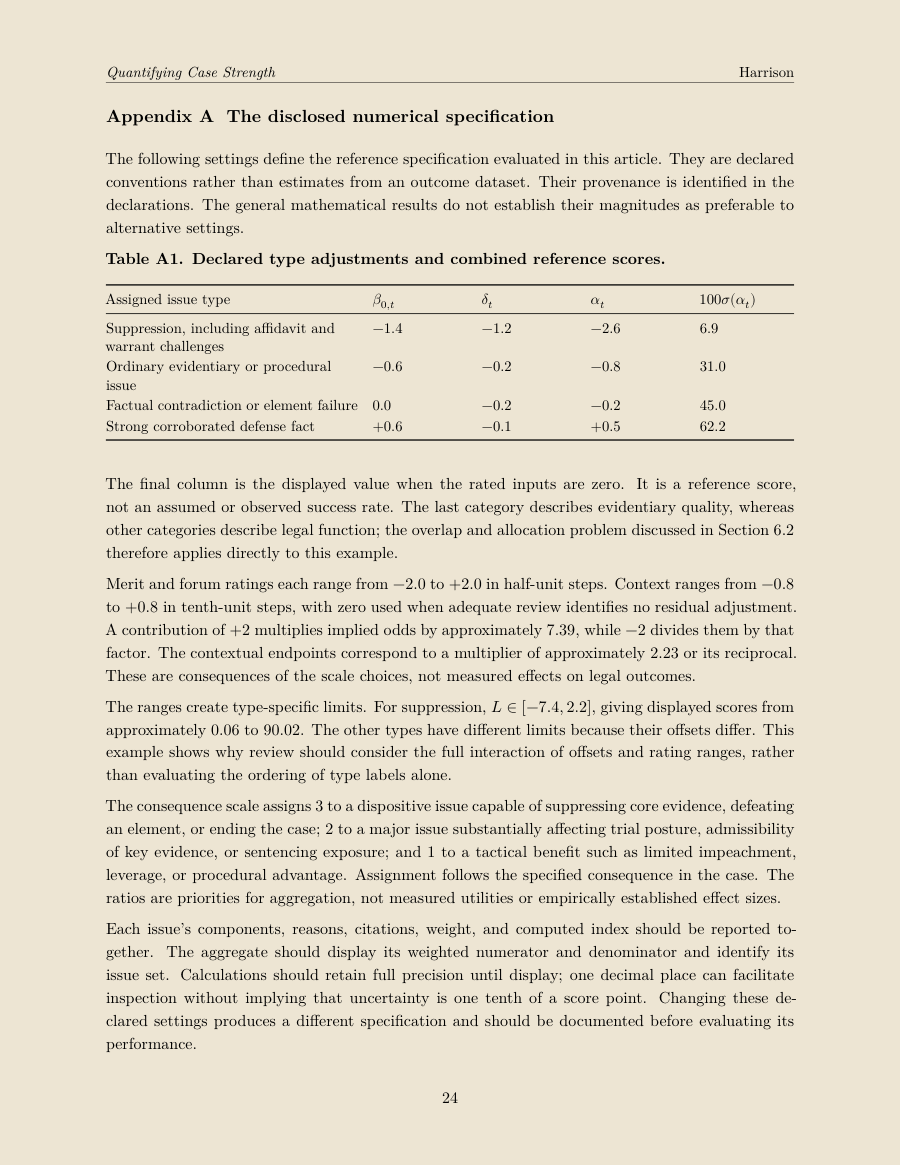
The following settings define the reference specification evaluated in this article. They are declared
conventions rather than estimates from an outcome dataset. Their provenance is identified in the
declarations. The general mathematical results do not establish their magnitudes as preferable to
alternative settings.
Table A1. Declared type adjustments and combined reference scores.
Assigned issue type
𝛽0,𝑡
𝛿𝑡
𝛼𝑡
100𝜎(𝛼𝑡)
Suppression, including affidavit and
warrant challenges
−1.4
−1.2
−2.6
6.9
Ordinary evidentiary or procedural
issue
−0.6
−0.2
−0.8
31.0
Factual contradiction or element failure
0.0
−0.2
−0.2
45.0
Strong corroborated defense fact
+0.6
−0.1
+0.5
62.2
The final column is the displayed value when the rated inputs are zero. It is a reference score,
not an assumed or observed success rate. The last category describes evidentiary quality, whereas
other categories describe legal function; the overlap and allocation problem discussed in Section 6.2
therefore applies directly to this example.
Merit and forum ratings each range from −2.0 to +2.0 in half-unit steps. Context ranges from −0.8
to +0.8 in tenth-unit steps, with zero used when adequate review identifies no residual adjustment.
A contribution of +2 multiplies implied odds by approximately 7.39, while −2 divides them by that
factor. The contextual endpoints correspond to a multiplier of approximately 2.23 or its reciprocal.
These are consequences of the scale choices, not measured effects on legal outcomes.
The ranges create type-specific limits. For suppression, 𝐿∈[−7.4, 2.2], giving displayed scores from
approximately 0.06 to 90.02. The other types have different limits because their offsets differ. This
example shows why review should consider the full interaction of offsets and rating ranges, rather
than evaluating the ordering of type labels alone.
The consequence scale assigns 3 to a dispositive issue capable of suppressing core evidence, defeating
an element, or ending the case; 2 to a major issue substantially affecting trial posture, admissibility
of key evidence, or sentencing exposure; and 1 to a tactical benefit such as limited impeachment,
leverage, or procedural advantage. Assignment follows the specified consequence in the case. The
ratios are priorities for aggregation, not measured utilities or empirically established effect sizes.
Each issue’s components, reasons, citations, weight, and computed index should be reported to-
gether. The aggregate should display its weighted numerator and denominator and identify its
issue set. Calculations should retain full precision until display; one decimal place can facilitate
inspection without implying that uncertainty is one tenth of a score point. Changing these de-
clared settings produces a different specification and should be documented before evaluating its
performance.
24

Quantifying Case Strength
Harrison
Appendix B Derivations supporting the sensitivity analysis
For a positive index shift 𝑑, the largest logistic display difference is obtained by maximizing
100{𝜎(𝑥+ 𝑑) −𝜎(𝑥)}. The derivative vanishes uniquely at 𝑥= −𝑑/2. The difference tends to
zero at either extreme and is positive between them, so this stationary point is the maximum. The
zero-shift case is immediate. Symmetry gives
max
𝑥
100|𝜎(𝑥+ 𝑑) −𝜎(𝑥)| = 100{2𝜎(|𝑑|/2) −1} = 100 tanh(|𝑑|/4).
For a symmetric index envelope [−ℎ, ℎ], the full score width is consequently 100 tanh(ℎ/2). With
ℎ= 1.1, this is approximately 50.0520 points. This width compares the two extreme reassessments,
not one extreme with the center.
For subdivision, let a parent have weight 𝑤and index 𝑥. Let 𝑅and 𝑄be the total weight and
weighted sum of the other issues. Replace the parent by children with total weight 𝑣and weighted
sum 𝑧. Requiring (𝑄+ 𝑤𝑥)/(𝑅+ 𝑤) = (𝑄+ 𝑧)/(𝑅+ 𝑣) for arbitrary surrounding (𝑅, 𝑄) first
equates the coefficients of 𝑄, giving 𝑣= 𝑤, and then requires 𝑧= 𝑤𝑥. Conversely, those conditions
preserve the mean immediately. Thus conservation of weight and weighted index contribution is
necessary and sufficient for invariance in arbitrary surrounding issue sets. A particular case can
exhibit accidental cancellation without satisfying the general condition.
The number of strict componentwise-dominance comparisons between a designated pair of types
follows from the component grids. Each nine-level core scale supplies 9×10/2 = 45 weakly ordered
pairs. The seventeen-level contextual scale supplies 17 × 18/2 = 153. Their product includes 1,377
identical profiles. Excluding those gives 452 ×153−1,377 = 308,448 strict dominance pairs. Integer
enumeration then partitions them according to whether the summed rating advantage is smaller
than, equal to, or larger than the type-offset gap.
Acknowledgments and declarations
Author and interests. Christopher R. Harrison is a trial attorney, an AI systems engineer, and
the founder of Analyzed Discovery Ltd., a Nevada software provider. He also has an ownership and
management role in Battlefront Legal LLC, a Nevada law firm, which holds a 0% ownership inter-
est in Analyzed Discovery Ltd. The numerical specification originated in the Analyzed Discovery
software project.
Materials and data availability. Supplementary Material 1 contains the proposed operational
codebook. Supplementary Material 2 contains the analysis plan, executable source and independent
verifier, complete enumerated profile grid, and machine-readable results. All numerical results can
be regenerated using Python 3.10 or later without external packages. No case records, participant
data, or judicial outcomes were used in the reported analytical study.
Funding. This work was supported by the author.
25

Quantifying Case Strength
Harrison
References
American Educational Research Association, American Psychological Association, & National
Council on Measurement in Education. (2014). Standards for educational and psychological testing.
American Educational Research Association. Publisher’s open-access edition.
Bex, F. J., van Koppen, P. J., Prakken, H., & Verheij, B. (2010).
A hybrid formal theory of
arguments, stories and criminal evidence. Artificial Intelligence and Law, 18(2), 123–152. DOI
10.1007/s10506-010-9092-x.
Bollen, K., & Lennox, R. (1991). Conventional wisdom on measurement. A structural equation
perspective. Psychological Bulletin, 110(2), 305–314. DOI 10.1037/0033-2909.110.2.305.
Brier, G. W. (1950). Verification of forecasts expressed in terms of probability. Monthly Weather
Review, 78(1), 1–3. Publisher’s article.
Cronbach, L. J., & Meehl, P. E. (1955). Construct validity in psychological tests. Psychological
Bulletin, 52(4), 281–302. DOI 10.1037/h0040957.
Dawes, R. M. (1979). The robust beauty of improper linear models in decision making. American
Psychologist, 34(7), 571–582. DOI 10.1037/0003-066X.34.7.571.
Douglas, K. S., Ogloff, J. R. P., & Hart, S. D. (2003). Evaluation of a model of violence risk
assessment among forensic psychiatric patients.
Psychiatric Services, 54(10), 1372–1379.
DOI
10.1176/appi.ps.54.10.1372.
Edwards, W., & Barron, F. H. (1994). SMARTS and SMARTER. Improved simple methods for
multiattribute utility measurement. Organizational Behavior and Human Decision Processes, 60(3),
306–325. DOI 10.1006/obhd.1994.1087.
Federal Rules of Evidence, rules 403–404. Official compilation.
Fenton, N., Neil, M., & Lagnado, D. A. (2013). A general structure for legal arguments about
evidence using Bayesian networks. Cognitive Science, 37(1), 61–102. DOI 10.1111/cogs.12004.
Franks v. Delaware, 438 U.S. 154 (1978). United States Reports.
Grove, W. M., Zald, D. H., Lebow, B. S., Snitz, B. E., & Nelson, C. (2000). Clinical versus me-
chanical prediction. A meta-analysis. Psychological Assessment, 12(1), 19–30. DOI 10.1037/1040-
3590.12.1.19.
In re Winship, 397 U.S. 358 (1970). United States Reports.
Kane, M. T. (2013). Validating the interpretations and uses of test scores. Journal of Educational
Measurement, 50(1), 1–73. DOI 10.1111/jedm.12000.
26
Quantifying Case Strength
Harrison
Koo, T. K., & Li, M. Y. (2016).
A guideline of selecting and reporting intraclass correlation
coefficients for reliability research.
Journal of Chiropractic Medicine, 15(2), 155–163.
DOI
10.1016/j.jcm.2016.02.012.
Luce, R. D., & Tukey, J. W. (1964). Simultaneous conjoint measurement. A new type of fun-
damental measurement.
Journal of Mathematical Psychology, 1(1), 1–27.
DOI 10.1016/0022-
2496(64)90015-X.
Medvedeva, M., & McBride, P. (2023). Legal judgment prediction. If you are going to do it, do
it right.
In Proceedings of the Natural Legal Language Processing Workshop 2023 (pp. 73–84).
Association for Computational Linguistics. DOI 10.18653/v1/2023.nllp-1.9.
Messick, S. (1995). Validity of psychological assessment. Validation of inferences from persons’
responses and performances as scientific inquiry into score meaning. American Psychologist, 50(9),
741–749. DOI 10.1037/0003-066X.50.9.741.
Paruolo, P., Saisana, M., & Saltelli, A. (2013). Ratings and rankings. Voodoo or science? Journal
of the Royal Statistical Society, Series A, 176(3), 609–634. DOI 10.1111/j.1467-985X.2012.01059.x.
Saisana, M., Saltelli, A., & Tarantola, S. (2005). Uncertainty and sensitivity analysis techniques
as tools for the quality assessment of composite indicators. Journal of the Royal Statistical Society,
Series A, 168(2), 307–323. DOI 10.1111/j.1467-985X.2005.00350.x.
Shrout, P. E., & Fleiss, J. L. (1979). Intraclass correlations. Uses in assessing rater reliability.
Psychological Bulletin, 86(2), 420–428. DOI 10.1037/0033-2909.86.2.420.
United States v. Leon, 468 U.S. 897 (1984). United States Reports.
Van Calster, B., McLernon, D. J., van Smeden, M., Wynants, L., & Steyerberg, E. W., on behalf
of Topic Group “Evaluating diagnostic tests and prediction models” of the STRATOS initiative.
(2019). Calibration. The Achilles heel of predictive analytics. BMC Medicine, 17, Article 230.
DOI 10.1186/s12916-019-1466-7.
Victor, M. B. (2015).
Decision tree analysis.
A means of reducing litigation uncertainty and
facilitating good settlements.
Georgia State University Law Review, 31(4), 715–739.
Journal
article.
27
Quantifying Case Strength
Harrison
Appendix C A Trial-Court Benchmark for Defense Issue Assessment
Proposed design · October 2026
This document develops a benchmark proposal for the methods paper.
It reports no collected
national sample, blinded predictions, or outcome-validation results. Its allocations are planning
choices, not an externally registered protocol or a completed sample-size calculation.
The supplied source collection has now received a local corpus assessment1. It contains a substantial
Nevada appellate and U.S. Supreme Court opinion pool, including 2,675 Nevada TXT records
in criminal-labeled folders. The earlier Nevada extraction can be reused. Adequate predecision
criminal trial-court packets and all-state coverage have not yet been established. The immediate
study should therefore begin with a separately reported, retrospective opinion-based cohort. The
national trial-court design below remains an expansion target, and its source requirements remain
applicable.
C.1 What the benchmark would test
The primary question is whether the existing issue-strength index assigns higher values to defense
issues that subsequently obtain a specified trial-court benefit than to comparable issues that do
not. That is evidence about predictive or criterion validity. Actual rulings do not, by themselves,
establish that a legal argument was normatively correct or that the full construct of defense issue
strength has been validated.
A second component would compare the index with experienced defense attorneys’ assessments of
the same record, made without seeing the index or the outcome. That supplies a different source
of evidence about the intended construct. The two components should be reported separately.
The unit is one identified issue from one case family, assessed at a specified point before a target
ruling. A benchmark question is a legally grounded case task, not a general legal-knowledge question.
It identifies the proposition, requested benefit, available evidence, governing law, procedural posture,
and target decision.
The primary cohort should consist of criminal-defense issues with a discernible trial-court ruling.
Suppression and admissibility questions are practical starting points.
Factual support and im-
peachment are not always resolved through a separate grant-or-denial ruling. They can enter the
attorney-assessment component, but a conviction or acquittal must not be used as a substitute
label for every underlying issue.
C.2 A concrete first allocation
The proposed 5,000–10,000 cases form a candidate inventory. They are not presumed to be complete,
eligible case files. One case may contain several potentially eligible issues, and one selected issue
may require several documents.
1Companion material supplied with the manuscript, benchmark_corpus/corpus_assessment.md.
28
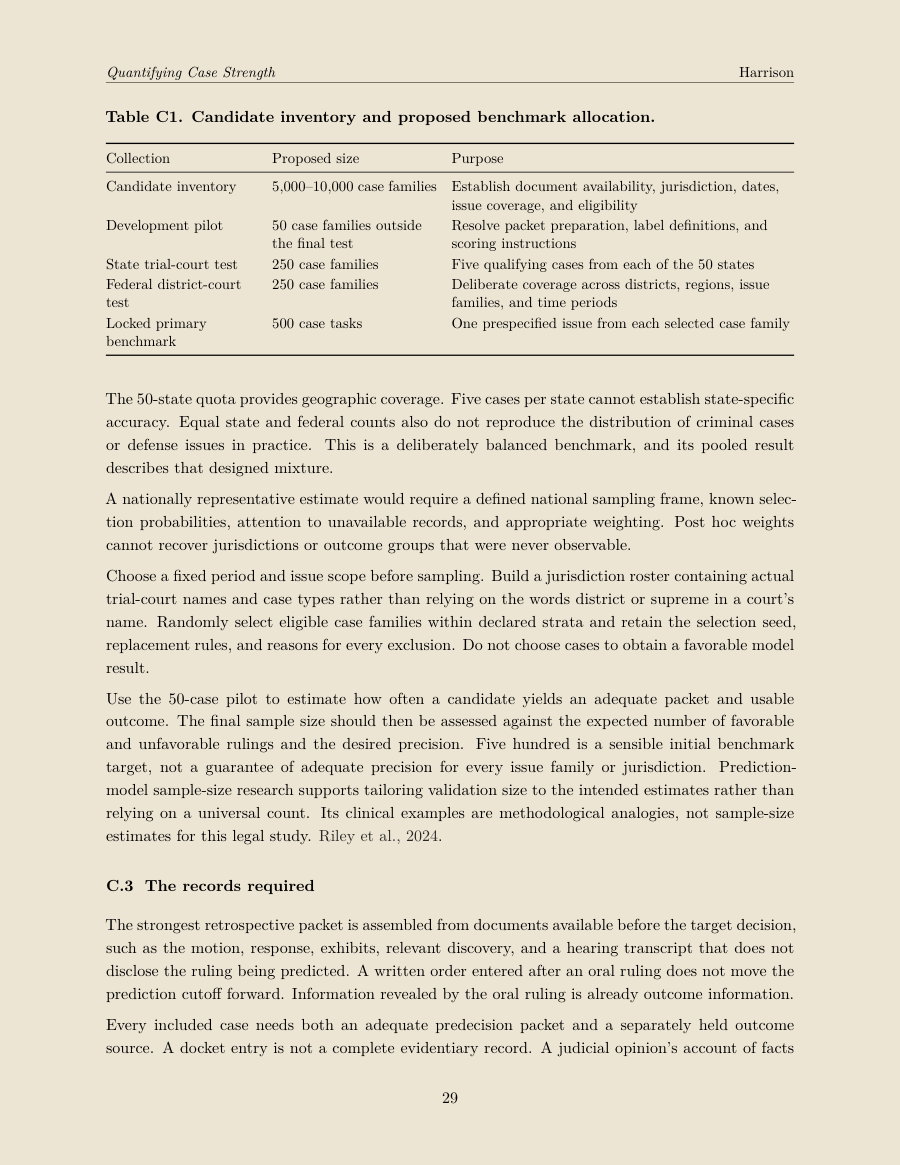
Quantifying Case Strength
Harrison
Table C1. Candidate inventory and proposed benchmark allocation.
Collection
Proposed size
Purpose
Candidate inventory
5,000–10,000 case families
Establish document availability, jurisdiction, dates,
issue coverage, and eligibility
Development pilot
50 case families outside
the final test
Resolve packet preparation, label definitions, and
scoring instructions
State trial-court test
250 case families
Five qualifying cases from each of the 50 states
Federal district-court
test
250 case families
Deliberate coverage across districts, regions, issue
families, and time periods
Locked primary
benchmark
500 case tasks
One prespecified issue from each selected case family
The 50-state quota provides geographic coverage. Five cases per state cannot establish state-specific
accuracy. Equal state and federal counts also do not reproduce the distribution of criminal cases
or defense issues in practice. This is a deliberately balanced benchmark, and its pooled result
describes that designed mixture.
A nationally representative estimate would require a defined national sampling frame, known selec-
tion probabilities, attention to unavailable records, and appropriate weighting. Post hoc weights
cannot recover jurisdictions or outcome groups that were never observable.
Choose a fixed period and issue scope before sampling. Build a jurisdiction roster containing actual
trial-court names and case types rather than relying on the words district or supreme in a court’s
name. Randomly select eligible case families within declared strata and retain the selection seed,
replacement rules, and reasons for every exclusion. Do not choose cases to obtain a favorable model
result.
Use the 50-case pilot to estimate how often a candidate yields an adequate packet and usable
outcome. The final sample size should then be assessed against the expected number of favorable
and unfavorable rulings and the desired precision. Five hundred is a sensible initial benchmark
target, not a guarantee of adequate precision for every issue family or jurisdiction. Prediction-
model sample-size research supports tailoring validation size to the intended estimates rather than
relying on a universal count. Its clinical examples are methodological analogies, not sample-size
estimates for this legal study. Riley et al., 2024.
C.3 The records required
The strongest retrospective packet is assembled from documents available before the target decision,
such as the motion, response, exhibits, relevant discovery, and a hearing transcript that does not
disclose the ruling being predicted. A written order entered after an oral ruling does not move the
prediction cutoff forward. Information revealed by the oral ruling is already outcome information.
Every included case needs both an adequate predecision packet and a separately held outcome
source. A docket entry is not a complete evidentiary record. A judicial opinion’s account of facts
29

Quantifying Case Strength
Harrison
is also not equivalent to the material available before the ruling. Its selection of facts and framing
of disputes can reveal the result even when the disposition is removed. Research on legal judgment
prediction identifies this distinction between forecasting and recognizing outcomes from decision
texts. Medvedeva and McBride, 2023.
Federal RECAP and PACER materials are candidate sources, subject to document-level coverage.
RECAP search can return case metadata without filings, and PACER excludes some categories
of material. A searchable case therefore is not automatically a usable scoring packet. Free Law
Project’s coverage explanation and PACER availability guidance.
State trial-court access requires a separate jurisdiction audit. For example, Maryland’s judiciary
reports that its online Case Search omits information about criminal charges ending in dismissal,
acquittal, or nolle prosequi, although some records remain accessible at the courthouse. This creates
a possible outcome-dependent sampling gap. It does not establish that the underlying records are
unavailable through every route. Maryland court-record guidance.
The candidate register must distinguish a located case, available docket metadata, available pre-
decision documents, an adequate scoring packet, and an adjudicated target outcome. Missingness
and exclusions should be reported by jurisdiction, issue family, time period, and outcome category
where the outcome can be lawfully established. Availability may depend on how a case ended, so
the final claims must address that selection.
The existing Nevada appellate collection can help develop extraction and masking procedures. It is
not a substitute for the national trial-court cohort. Supreme court and other appellate decisions be-
long in a separate appellate test, with their own prediction time, standard of review, and requested
relief.
C.4 Normalize structure and mask identity without changing the legal problem
Normalization should standardize document structure, encoding, fields, and source locators. Iden-
tity masking should replace irrelevant names, captions, docket numbers, filenames, and target-
decision identifiers with stable aliases.
Do not change everything. Preserve the relationships among people, disputed status of assertions,
quantities, ages, timing, jurisdiction, and other facts that affect the legal analysis. Changing those
facts may create a different case for which the original ruling is no longer an appropriate comparison.
Remove the target ruling, later appellate history, headnotes, outcome-revealing summaries, and
reasoning that resolves the target issue. Retain earlier rulings only when they were available at the
prediction time and concern a different decision. Assemble governing authority as of that time and
exclude the target opinion and its subsequent treatment.
Each proposition must retain a private source locator and a neutral evidence identifier in the
scoring packet. A reviewer should verify that preparation has preserved both favorable and adverse
evidence. A normalization model must not silently transform an allegation into an established fact.
30
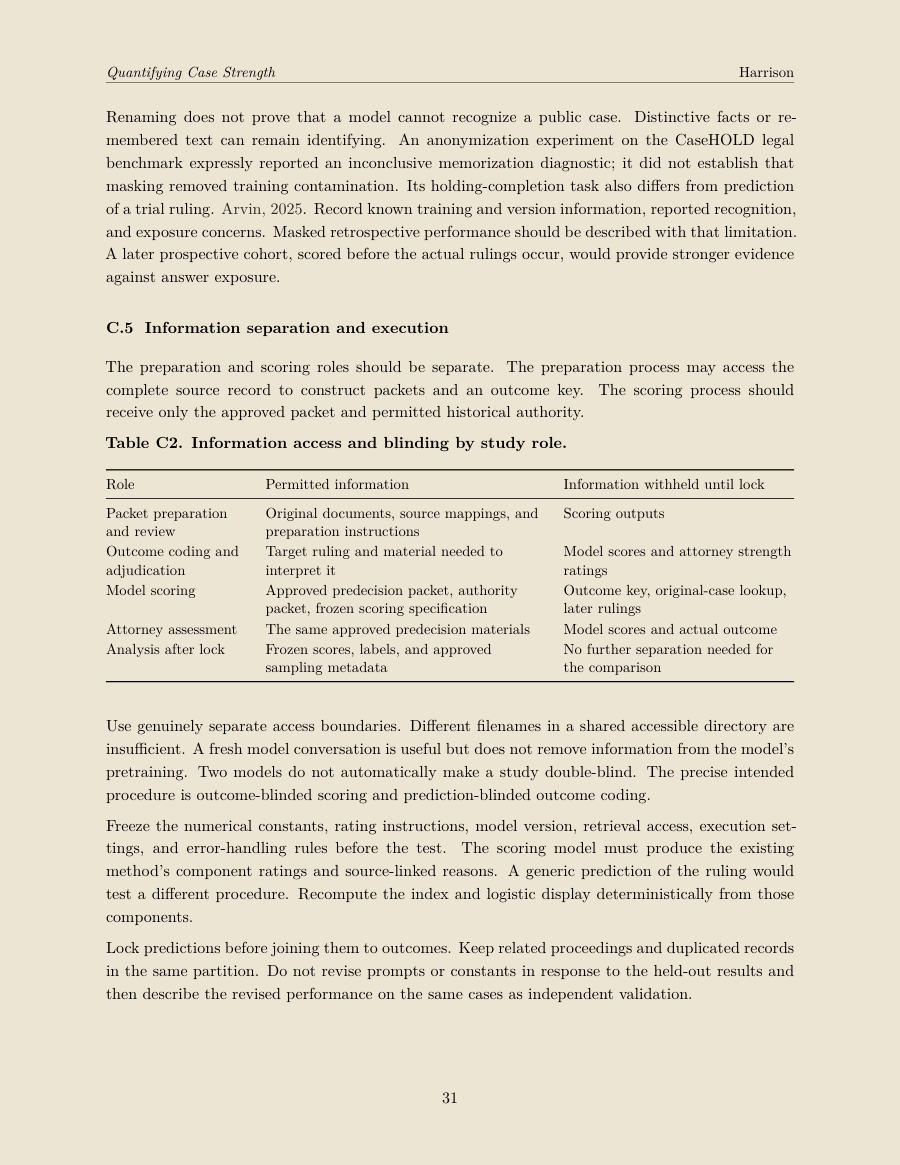
Quantifying Case Strength
Harrison
Renaming does not prove that a model cannot recognize a public case. Distinctive facts or re-
membered text can remain identifying. An anonymization experiment on the CaseHOLD legal
benchmark expressly reported an inconclusive memorization diagnostic; it did not establish that
masking removed training contamination. Its holding-completion task also differs from prediction
of a trial ruling. Arvin, 2025. Record known training and version information, reported recognition,
and exposure concerns. Masked retrospective performance should be described with that limitation.
A later prospective cohort, scored before the actual rulings occur, would provide stronger evidence
against answer exposure.
C.5 Information separation and execution
The preparation and scoring roles should be separate. The preparation process may access the
complete source record to construct packets and an outcome key.
The scoring process should
receive only the approved packet and permitted historical authority.
Table C2. Information access and blinding by study role.
Role
Permitted information
Information withheld until lock
Packet preparation
and review
Original documents, source mappings, and
preparation instructions
Scoring outputs
Outcome coding and
adjudication
Target ruling and material needed to
interpret it
Model scores and attorney strength
ratings
Model scoring
Approved predecision packet, authority
packet, frozen scoring specification
Outcome key, original-case lookup,
later rulings
Attorney assessment
The same approved predecision materials
Model scores and actual outcome
Analysis after lock
Frozen scores, labels, and approved
sampling metadata
No further separation needed for
the comparison
Use genuinely separate access boundaries. Different filenames in a shared accessible directory are
insufficient. A fresh model conversation is useful but does not remove information from the model’s
pretraining. Two models do not automatically make a study double-blind. The precise intended
procedure is outcome-blinded scoring and prediction-blinded outcome coding.
Freeze the numerical constants, rating instructions, model version, retrieval access, execution set-
tings, and error-handling rules before the test.
The scoring model must produce the existing
method’s component ratings and source-linked reasons. A generic prediction of the ruling would
test a different procedure. Recompute the index and logistic display deterministically from those
components.
Lock predictions before joining them to outcomes. Keep related proceedings and duplicated records
in the same partition. Do not revise prompts or constants in response to the held-out results and
then describe the revised performance on the same cases as independent validation.
31

Quantifying Case Strength
Harrison
C.6 Outcome labels and independent judgment
Define the requested benefit from the predecision materials before inspecting the disposition used
as the label. The primary binary endpoint is whether the trial court granted that prespecified
benefit. The label manual must state how partial grants, alternative grounds, procedural denials,
withdrawal, mootness, and unresolved issues are handled.
Keep those original categories even when a binary label is derived.
A finding of error is not
necessarily the relief sought. An unreached or withdrawn issue is not automatically a defense loss.
Such issues belong in the benchmark’s accounting and may fall outside the primary adjudicated-
issue analysis.
Two independent legally qualified coders should label outcomes without seeing model predictions,
with disagreements adjudicated before the join. Model-assisted extraction can reduce preparation
work, but the final reference label must have a reviewed source basis.
For the construct component, obtain independent attorney assessments on a prespecified subset,
provisionally 100 of the test packets. Attorneys should judge strength without the scorecard formula
or output and assess consequence separately. Record their disagreement as well as their agreement
with the index. The developer’s own ratings are not an independent validation panel.
An issue-ruling study will not validate the overall case mean or the 3–2–1 consequence weights.
Those require their own criterion. It also will not, by itself, test whether the full automated system
identifies every important issue in raw discovery. Supplying an already identified issue evaluates
the scoring stage.
C.6.1 Governing law, court practice, and the decision sequence
The study should distinguish the standard supplied by governing authority from the standard a
court states and the analysis it actually performs.
It should also distinguish an assessment of
legal correctness from an estimate of how comparable issues are decided. A historical ruling is an
observation of court behavior. It does not establish, by itself, that the legal analysis was correct.
An appellate opinion can identify an earlier trial-court issue and ruling where it describes them
sufficiently clearly.
Extract those observations with their source basis, retaining the appellate
proceeding as a separate event. The earlier issue, the issue preserved for review, and the issue ulti-
mately reached may differ. Do not assume that a complete predecision record can be reconstructed
merely because the opinion states what happened below.
Table C3. Decision sequence and required observations.
Record field
Required content
Exact issue and requested
benefit
The challenged element, evidence, procedure, or legal proposition and the
relief sought at the identified stage
Target decision
Court, court level, procedural stage, decision date, and information cutoff
Governing standard
Applicable authority as of the cutoff and the substantive decision rule it
supplies
32

Quantifying Case Strength
Harrison
Record field
Required content
Stated standard
The target court’s express formulation, with a source locator, or an explicit
indication that the available source does not disclose it
Applied analysis
The evidence, elements, inferences, and legal conditions the court actually
addresses, to the extent the record permits observation
Issue-specific outcome
Benefit granted, denied, partly granted, or not reached, with the supporting
source
Subsequent review
Reviewing court, issue actually reviewed, standard of review, and
disposition, recorded separately from the earlier ruling
Observation quality
Original transcript or order, quoted lower-court passage, appellate
paraphrase, or unavailable information
The target court’s reasoning and disposition belong on the outcome side of the information barrier.
They cannot be used to construct that same decision’s forum rating. An earlier ruling can be a
legitimate input when the target is a later appeal, subject to the declared cutoff. These uses must
not be interchanged.
For the present specification, historical practice may inform the forum component through its
stated rationale. Evidentiary merit remains a separate assessment. Keep the account of governing
law and the account of institutional practice distinguishable in the rationale without introducing
an undisclosed extra score or changing the frozen constants. When the sources do not support a
practice estimate, record that limitation rather than assign an invented jurisdictional rate.
The Nevada probable-cause research note2 supplies a concrete example. The statutory requirement,
judicial descriptions of the low evidentiary threshold, and the actual application to a disputed
element should be recorded separately. The Supreme Court’s own abbreviated formulations make
terminology alone an inadequate indicator of doctrinal departure.
This example motivates an
empirical question about application and does not establish a statewide practice finding.
C.6.2 The reported any-evidence practice
The practitioner observation motivating this part of the pilot concerns the operative decision rule.
The hypothesis is that the presence of some inculpatory evidence is treated as sufficient to continue
a prosecution even when the defense challenges the inferential connection between that evidence and
a required element. This is a reported practice to investigate, rather than an established frequency
or a premise that every arrest results in trial.
For an eligible probable-cause issue, preparation should identify the evidence relied on, the interme-
diate factual propositions needed to connect it to the disputed element, the basis for each inferential
step, the defense’s objection, and the court’s recorded response. Distinguish an inference the court
expressly adopts from one reconstructed by the preparer. A source that omits the court’s reasoning
should be coded as insufficiently informative about that reasoning. Omission from an appellate
summary does not establish that the lower court performed no analysis.
2Companion material supplied with the manuscript, research/nevada_probable_cause_standard.md.
33

Quantifying Case Strength
Harrison
Reviewers should assess the support for each inferential step separately from the observed ruling
and without seeing model scores. Record supported, contested, unsupported, or indeterminate links
with reasons and source references. A longer inference chain is not automatically defective. The
relevant question is whether the necessary connections have a defensible basis under the applicable
standard. This review supplies an additional observation about evidentiary reasoning; it introduces
no automatic chain-length penalty or new numerical input into the frozen score.
The record can therefore preserve a well-supported defense objection together with a ruling that
allows the prosecution to continue. Observed reception informs the study of forum behavior. It
must not retroactively determine whether the underlying evidence supports the defense proposition.
C.7 Comparisons and reporting
The primary analysis should report how well the frozen index orders favorable and unfavorable
outcomes, including area under the ROC curve and uncertainty. Report federal and state results
separately and show results by issue family where the data support estimation. Court-level or
case-family dependence must be addressed in the uncertainty procedure selected before the test.
Historical practice should be summarized collectively by legally comparable issue, jurisdiction, pro-
cedural stage, and period. Individual judge rankings are outside this design. Record both the
numerator and the population of observable decisions behind a frequency. A collection selected
through appellate review estimates patterns among the observed reviewed cases; it does not estab-
lish how often all trial-court judges rule that way across all eligible matters. Using a familiar phrase
is also insufficient to establish a departure from governing law. That claim requires examination
of the analysis applied to the particular evidentiary and legal requirements.
Any historical information used to assess a target decision must predate that decision and come
from the permitted development or reference material. Keep related proceedings together when
separating development and evaluation.
A later-period evaluation can test whether an earlier
collective pattern remains informative, with changes in governing law and the composition of cases
reported. Historical frequencies alone do not establish future performance.
Compare the full score with a type-only score, merit-only and forum-only scores, and the same
underlying model making a judgment from the same packet without the scorecard. The comparison
with the type-only score is particularly important because different issue families may have different
outcome frequencies. Report paired performance differences and their uncertainty rather than only
a headline accuracy number.
For the probable-cause subset, report how often prosecution continues and how often the specified
defense relief is granted. If a binary decision rule is evaluated using a threshold fixed before testing,
include an always-continue comparator. A high agreement rate in a nearly uniform outcome sample
may reveal little about assessment of issue strength. If only one outcome category is observed,
discrimination between favorable and unfavorable outcomes cannot be estimated in that subset.
Report that limitation directly and retain the separate review of evidentiary reasoning. Do not
force a 50-point threshold onto the uncalibrated score to manufacture this comparison.
34

Quantifying Case Strength
Harrison
The 0–100 display is currently an uncalibrated index. Do not automatically treat 50 as a win-
loss threshold or 70 as a 70% probability. If a probability mapping is developed, estimate it on
development cases and evaluate the frozen mapping on the untouched test. Report discrimination
and calibration separately, with the Brier score as overall probabilistic prediction error. Do not
equate good ranking with good probability calibration.
Do not artificially force equal numbers of wins and losses in the primary sample merely to make
a balanced exam. Jurisdiction balance and outcome balance are different choices. A deliberately
outcome-enriched auxiliary set can test rare situations, but it must be labeled and analyzed sepa-
rately.
Report every attempted packet, exclusion, missing document, coding disagreement, failed execution,
unscorable issue, and suspected exposure. A system’s refusal to score an eligible packet should
remain visible as a coverage result rather than silently disappear from its accuracy denominator.
C.8 Recommended sequence
1. Audit candidate-source coverage and identify predecision trial records, beginning with a limited
set of federal districts and state jurisdictions.
2. Prepare and review 50 development packets, finalize the issue and label manuals, and estimate
record yield and outcome frequency.
3. Set the final allocations and precision targets, then preregister the protocol and freeze the
scoring system.
4. Prepare the independently sampled 500-case test, keeping all related proceedings outside de-
velopment.
5. Lock model scores, attorney assessments, and adjudicated outcome labels before comparison.
6. Publish the protocol, sampling flow, permitted benchmark materials, evaluation code, and all
prespecified results. Retain or refresh a separate private test set because public release can
expose future models to the answers.
The immediate recommendation, given the supplied corpus, is to begin the 50-case development
stage with screened Nevada appellate opinions and evaluate whether a separate 400–500-case
opinion-based test can be supported. That study must report its reconstructed information con-
ditions and potential outcome leakage.
The balanced 500-case trial-court design should follow
when suitable predecision records and jurisdiction coverage are available. Results from the two
information settings should be reported separately.
35